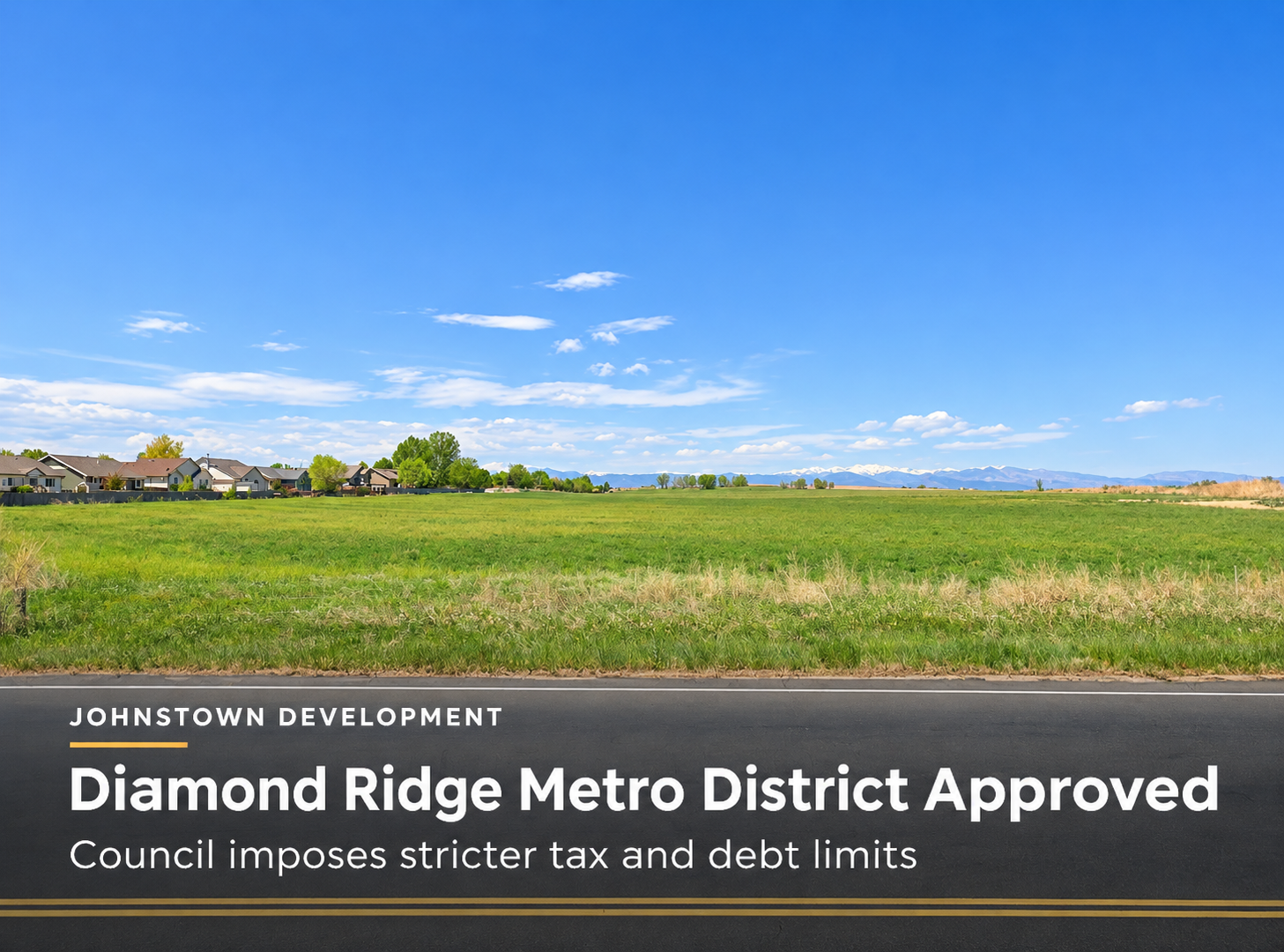
Town Council requires a single-district structure, reduces proposed debt-related tax limits and adds homeowner oversight protections.
JOHNSTOWN, Colo. — The Johnstown Town Council conditionally approved a service plan for the proposed Diamond Ridge Metropolitan District on November 2, 2026, requiring changes to the district’s structure, taxing authority and governance before the proposal moves forward.
The council’s conditions include consolidating three proposed metropolitan districts into one, reducing the maximum debt-service property tax levy from 40 mills to 30 mills, and shortening the maximum period for collecting debt-service taxes on an individual residential property from 40 years to 30 years.
The proposed district would serve approximately 93 acres southwest of the intersection of Weld County Road 50 and Telep Avenue. Preliminary development estimates anticipate approximately 328 single-family homes, potentially accommodating 820 residents. The council’s action concerns financing and governance for future infrastructure, not approval of the residential development itself.
The proposal was considered as Item 13 during the council’s November 2 public hearing. Source: Town of Johnstown, Official Meeting Agenda
How the Metropolitan District Would Work
Metropolitan districts are special-purpose local governments authorized under Colorado law to finance certain public improvements. They are frequently used in new developments to pay for infrastructure such as roads, water and sewer systems, and storm drainage facilities.
These districts can issue debt to finance eligible improvements and use property taxes collected within their boundaries to repay that debt. As a result, homeowners within a metropolitan district may pay additional property taxes beyond those imposed by existing local governments.
The submitted Diamond Ridge proposal contemplated up to $15 million in aggregate debt for public infrastructure. Costs exceeding the district’s available financing would generally remain the developer’s responsibility under the proposed arrangement.
The district’s financing authority would not require it to borrow the full $15 million. Actual borrowing would depend on infrastructure costs, financial feasibility and future district decisions.
Colorado law requires metropolitan district service plans to identify maximum debt and debt-service property tax limits. Source: Colorado General Assembly, Senate Bill 23-110
Council Reduces Taxing Authority and Debt Collection Period
One of the most significant changes imposed by the council was reducing the proposed maximum debt-service mill levy from 40 mills to 30 mills.
A mill is a property tax equal to $1 annually for every $1,000 of assessed property value. For example, a 30-mill levy would result in $300 in annual property taxes on a property with an assessed value of $10,000. Assessed value is not the same as a home’s market value or purchase price. In Colorado, assessed value is calculated using state-established assessment rates, meaning the actual tax owed depends on the property’s valuation and applicable tax rules.
The proposed service plan also provided for an operations and maintenance levy of up to 10 mills, subject to applicable limitations. That levy would be separate from the tax used to repay district debt.
The proposed service plan includes provisions allowing adjustments to mill levies when property assessment methods or rates change. Such adjustments are intended to account for changes in the assessed value used to calculate property taxes. Consequently, the 30-mill limit should not be interpreted as an absolute ceiling under every future circumstance. The specific adjustment provisions remain subject to the terms of the final approved service plan.
Councilmembers also shortened the maximum debt-service tax collection period for an individual residential property from 40 years to 30 years. That provision limits how long a particular property can be subjected to the district’s debt-service levy under the applicable service plan terms; it does not necessarily require all district debt to be retired within 30 years.
These restrictions are intended to limit the potential tax burden on future homeowners while maintaining a mechanism for financing development-related infrastructure.
Homeowner Oversight and Infrastructure Requirements
The revised plan must provide for homeowners, referred to as end users in district governance documents, to obtain majority control of the district board no later than the earlier of substantial completion of development or the sale and closing of 50% of the residential lots.
Metropolitan districts formed before homes are constructed are often initially controlled by individuals associated with the development. The homeowner-control requirement establishes a transition point at which residents are expected to gain greater authority over district operations and financial decisions.
Additional conditions require streets, water, sewer and storm drainage infrastructure to be dedicated to the Town of Johnstown following completion and acceptance. This would place qualifying public improvements under town ownership rather than leaving them permanently under district control.
Councilmembers Question Timing and Financial Implications
The proposed district generated extended discussion about development planning, long-term financial obligations and transparency for future property buyers.
Councilmember Dianne Morris raised concerns about approving a financing arrangement before more detailed neighborhood development plans had been reviewed. She also questioned the potential effects on nearby residents and whether infrastructure costs should be financed through debt ultimately repaid by homeowners.
Councilmember Nick Bashford questioned documentation supporting the public hearing notice and emphasized the importance of informing prospective homebuyers about metropolitan district taxes. The discussion also identified discrepancies in the proposed paperwork, including a reference to Larimer County District Court despite the proposed district being located in Weld County.
Town legal counsel addressed the public notice questions and indicated that the county reference could be corrected.
The discussion reflected competing considerations surrounding metropolitan districts. Supporters of the financing mechanism maintain that it can provide a way to fund public infrastructure while spreading costs over time. Critics question whether the resulting debt obligations place too much financial responsibility on homeowners who were not involved when the district was established.
What the Approval Means for Diamond Ridge
The council’s decision establishes conditions for the proposed metropolitan district service plan but does not approve a final subdivision layout, authorize construction or guarantee that the anticipated 328 homes will be built.
Future development remains subject to applicable land-use, subdivision and engineering reviews. The district must also proceed through the separate legal requirements governing the organization of metropolitan districts in Colorado.
The original public hearing notice identified the proposed district boundaries and outlined the requested authority to finance public improvements through property taxes. Source: Diamond Ridge Metropolitan District Public Hearing Notice, October 10, 2026
For prospective homebuyers, the district’s eventual debt obligations and property tax rates will be important considerations. Those costs will depend on future financing decisions, assessed property values and the final terms governing the district.
The November 2 approval represents an early step in the Diamond Ridge development process, establishing a more restrictive financial and governance framework while leaving the final residential plans subject to further review.