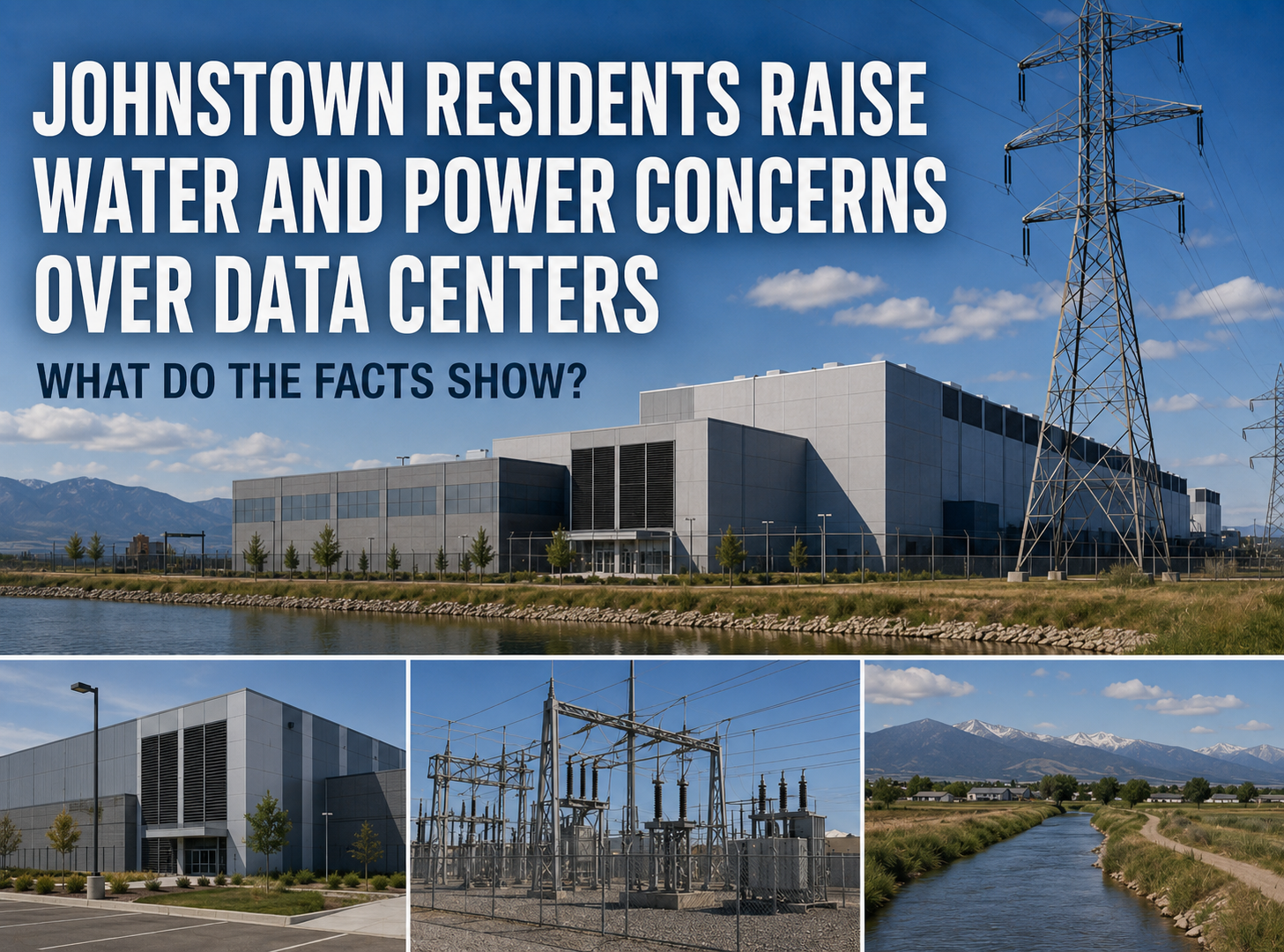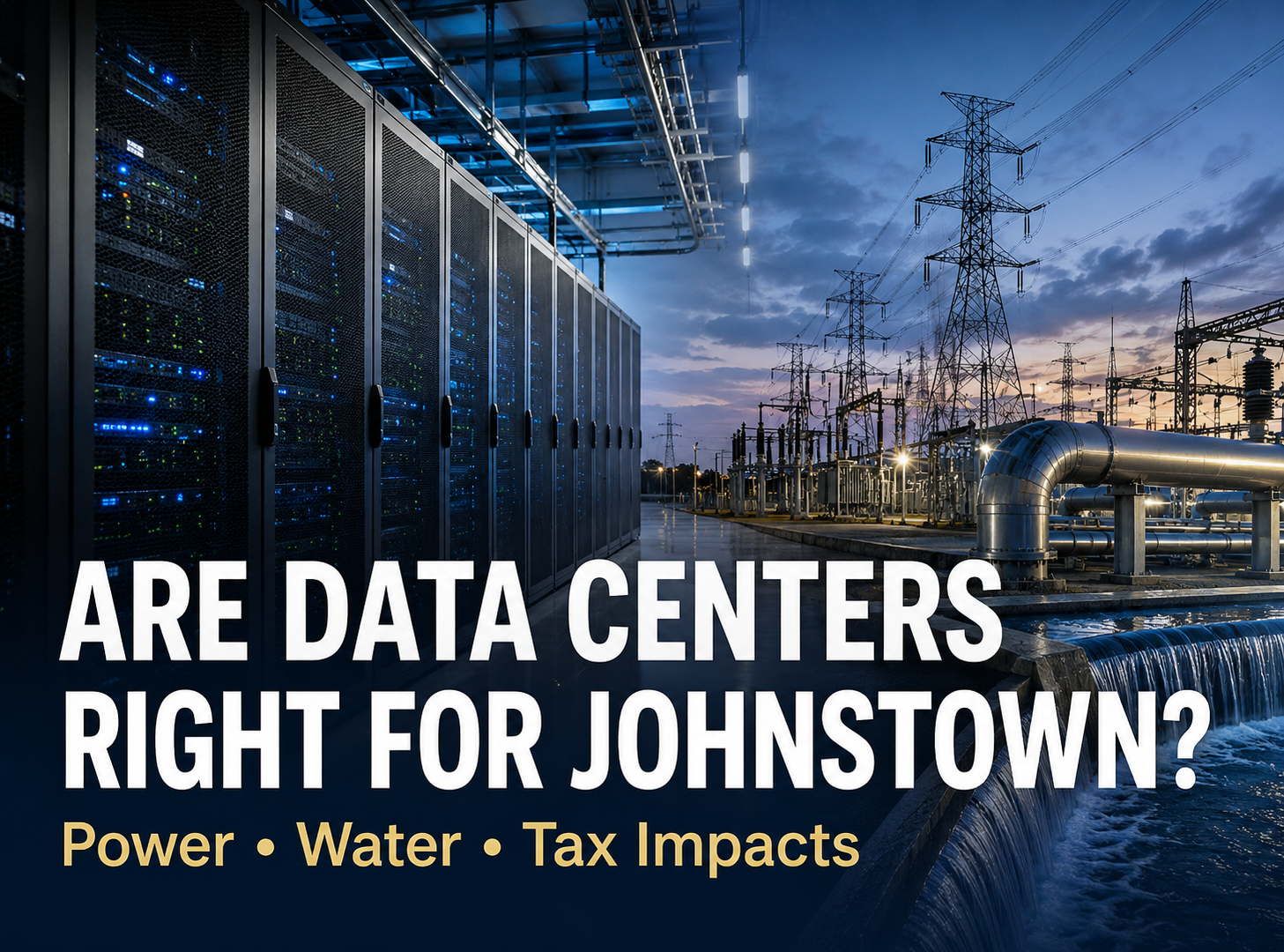
Johnstown town leaders will take up a broader economic development question Monday: whether data centers should have a place in the community and, if so, under what conditions.
The discussion is scheduled for the Town Council work session at 6 p.m. July 13. Town documents do not identify a specific data center project or developer seeking approval in Johnstown. Instead, staff is asking council to provide direction on whether the town should create policies governing future data center development.
The question presents Johnstown with competing considerations. Data centers can bring substantial private investment and tax revenue while placing relatively little demand on municipal services once operational. At the same time, large facilities can consume significant amounts of electricity and land while creating fewer permanent jobs than many other commercial or industrial uses.
That debate is expected to shape Monday’s discussion as council considers whether Johnstown should allow the industry, regulate it more specifically or potentially prohibit data centers within town limits.
Not All Data Centers Are the Same
Data centers house servers, storage systems and other digital infrastructure used to process and distribute large amounts of information. They operate around the clock and rely on continuous power, cooling systems, backup infrastructure and security.
Town staff broadly separates the industry into boutique facilities and hyperscale campuses. Boutique data centers typically use between 1 and 15 megawatts of power and can occupy relatively compact sites, while hyperscale facilities, often associated with major technology companies, can require 100 to more than 1,000 megawatts and may be developed as large campuses over several years.
The distinction matters for Johnstown because the effects of a smaller regional facility would be substantially different from those of a hyperscale campus.
Power Demand Is a Central Concern
Town staff estimates Johnstown’s 8,097 housing units collectively use approximately 26 megawatts of electricity during peak demand. For comparison, the town’s report estimates 10 megawatts is roughly equivalent to the electricity use of 3,086 homes, while a 100-megawatt load is equivalent to approximately 30,863 homes under the same illustrative comparison.
Unlike residential users, data centers operate continuously and require uninterrupted power. Staff notes that existing Colorado power providers would need significant infrastructure investment to accommodate large data center loads in the near term.
Xcel Energy and United Power have established large-load processes requiring major power users to fund studies and infrastructure improvements associated with their demand. Those processes are intended to address the infrastructure needs of large users while limiting cost and reliability impacts on existing customers. The town’s memo states that Poudre Valley Rural Electric Association currently does not have a formal large-load process.
For Johnstown, the question is not simply whether electricity is available today, but what infrastructure would be required to serve a major facility and who would pay for those improvements.
Water Use Depends Heavily on Cooling Technology
Water consumption is another major consideration, although the amount a data center uses can vary significantly depending on the cooling system selected. Open-loop systems rely on evaporation and have the highest relative water use among the technologies reviewed by town staff, while closed-loop systems recirculate water rather than continuously discharging it. Direct-to-chip cooling delivers liquid coolant directly to processors and can reduce the energy required to remove heat.
The technology is also changing rapidly. Earlier this month, nuclear startup Valar Atomics announced a partnership with Nvidia to develop a small data center in Utah intended to demonstrate how AI computing facilities could dramatically reduce water consumption. Reuters reported that the project would pair Valar’s Ward 250 microreactor with Nvidia computing technology as the companies seek to develop a nearly waterless facility.
The helium referenced in the project is used as the coolant in Valar’s Ward 250 reactor, not to cool Nvidia’s computer processors. Nvidia’s newer DSX data center design instead relies on a closed-loop liquid cooling system and dry coolers that reject heat without routinely relying on evaporative cooling. Nvidia says the design can operate with essentially zero facility-cooling water consumption, except for limited chiller use that may be needed during a small portion of the year in some climates.
The Utah project does not eliminate broader concerns about data center water consumption, particularly for facilities using traditional evaporative cooling, but it does illustrate why the specific technology proposed for a future facility could be as important as the size of the data center itself.
Town staff also identifies recycled water and waste heat recovery as technologies communities may consider when developing standards. Waste heat generated by servers can be captured and reused to heat nearby buildings, greenhouses or industrial facilities. The town’s report points to the National Renewable Energy Laboratory in Golden, where NREL uses waste heat captured from its data center to heat office and laboratory space. The report cites a 220,000-square-foot facility and says the system has operated since 2010.
For Johnstown, those differences could allow future standards to focus on a project’s actual water demand and cooling technology rather than treating every data center the same.
The Financial Case for Data Centers
The potential tax revenue is one of the strongest arguments in favor of data center development because the facilities can represent significant capital investment in buildings, infrastructure, servers and other equipment. That investment can generate property and personal business property tax revenue.
Data centers also generally require fewer municipal services once operational than many other types of development. They produce relatively little traffic after construction and place limited demand on schools, parks and other community services.
To illustrate the potential fiscal impact, town staff prepared a fictional example involving a 35-megawatt data center with $2 billion in new machinery and equipment investment. Under a five-year depreciation scenario, the hypothetical project could generate approximately $38.8 million in Town of Johnstown tax revenue before incentives. If the town refunded 50% of eligible revenue to the company under a hypothetical economic development agreement, Johnstown would retain approximately $19.4 million in net new revenue over the five-year period.
The example is illustrative and is not connected to an actual project proposed in Johnstown.
The Other Side of the Debate
The financial benefits come with tradeoffs. Data centers generally have low employment density, meaning they create relatively few permanent jobs compared with the amount of land and infrastructure they use. Although construction can produce significant temporary employment and operational positions can include well-paid technical jobs, the long-term workforce impact is typically limited.
Town staff also identifies a limited multiplier effect as a drawback. Compared with other commercial or industrial uses, the report says data centers typically generate less secondary economic activity for sectors such as retail and hospitality.
Land use could also become a significant consideration in Johnstown. The town’s memorandum states fewer than 160 acres west of Interstate 25 are currently zoned I-1 and could independently accommodate a data center application through the existing review process.
Using industrial land for a large data center could limit opportunities for other employers or developments that produce more jobs and daily economic activity. Town staff also notes that rapidly changing technology could create uncertainty about whether specialized data center buildings can be easily adapted for other uses in the future.
The issue facing council is therefore broader than whether data centers can generate tax revenue. It is whether the long-term financial return justifies the land and utility resources such facilities may require.
Johnstown’s Current Code Was Not Written for Data Centers
Johnstown’s Land Use Development Code does not currently define data centers as a separate land use. Under existing regulations, a data center would be classified as a warehouse with indoor storage and could be considered through a Use by Special Review process in light or heavy industrial zoning districts.
An application could be processed under the current code, but the town does not have standards specifically addressing the characteristics of data centers, including electrical demand, cooling systems, water consumption, backup power, noise and environmental impacts. That gap is one reason staff is seeking council direction before a future project arrives.
Council Asked Whether Johnstown Should Allow Them at All
Monday’s work session will ask council to consider several fundamental policy questions, beginning with whether data centers should be permitted by right, reviewed through a Use by Special Review process or prohibited within the town.
Council will also consider whether Johnstown should create a dedicated land-use classification for data centers and whether separate standards should apply to boutique and hyperscale facilities. Other questions include where data centers could be located, what requirements should address power and water demand, and whether the town should offer economic development incentives.
If incentives are considered, staff is asking whether companies should be required to meet specific performance standards tied to capital investment, job creation, wages, renewable energy, water conservation, waste heat recovery or public infrastructure improvements.
The town’s staff report does not recommend simply approving or rejecting data center development. Instead, it asks council to decide what type of development, if any, is appropriate for Johnstown and what benefits the community should require in return.
The July 13 meeting is a work session, and the published agenda does not list a formal vote on a data center policy.
What do you think?
After considering the potential tax revenue, utility demands and land-use tradeoffs, what do you think?