The Johnstown Town Council will consider a proposal Monday, October 19, to permanently reduce the Town’s property tax mill levy by eight mills over four years. The proposal could lower property taxes for homeowners and businesses while reducing annual Town revenue by approximately $4.7 million once fully implemented, based on current estimates.
Councilmember Nicholas Bashford’s proposal, Ordinance 2026-299, would reduce Johnstown’s municipal mill levy from 23.947 to 15.947 mills through four annual reductions of two mills each. The ordinance is scheduled for consideration on first reading during Monday’s 7 p.m. Town Council meeting.
Town staff is recommending against the permanent reduction, citing concerns about long-term revenue, infrastructure investments, and the Town’s ability to respond to future financial needs. Both the proposal and staff’s assessment are included in the October 19 Town Council meeting packet.
How the Proposed Property Tax Reduction Would Work
A mill levy determines the amount of property tax collected based on a property’s assessed value. One mill equals $1 in taxes for every $1,000 of assessed value.
Under Ordinance 2026-299, Johnstown’s municipal mill levy would decrease by two mills annually, with each reduction building on the previous year’s decrease. The first reduction would take effect at the first December property tax certification following the ordinance’s final adoption and effective date.
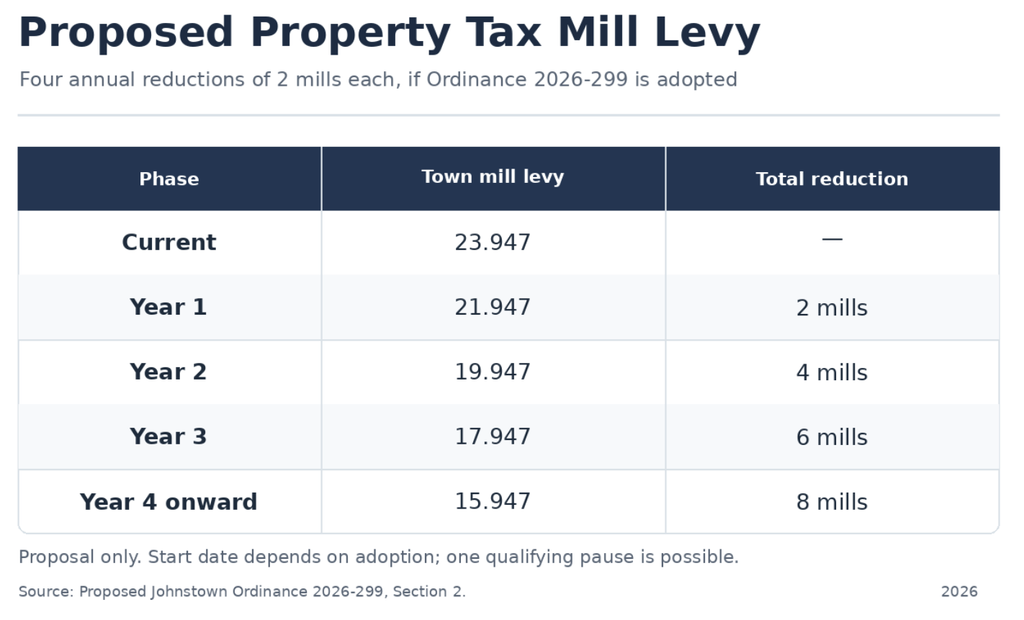
The full eight-mill reduction would represent approximately a 33% decrease in the Town’s overall municipal mill levy. The ordinance is structured so that each reduction would take effect automatically without requiring another Council vote each year.
The proposal would also allow a one-year pause if Johnstown’s total assessed property valuation decreases by more than 10% or certain disaster emergencies occur. Only one pause would be permitted, extending the full implementation period to a maximum of five years.
Unlike a temporary property tax credit or rebate, the proposal is intended to permanently reduce the Town’s underlying mill levy. Restoring a previously reduced rate would be subject to the ordinance’s voter-approval provisions, although future reductions that have not yet taken effect could be changed through another ordinance.
How Much Could Homeowners Save?
According to the financial analysis prepared by Bashford, a home with a county-assessed actual value of $500,000 would save approximately $61 in the first year. Annual savings would increase to approximately $245 once the full reduction takes effect, with cumulative savings of about $612 over the first four years.
Estimated savings would vary depending on the property’s actual value as determined by the county assessor.
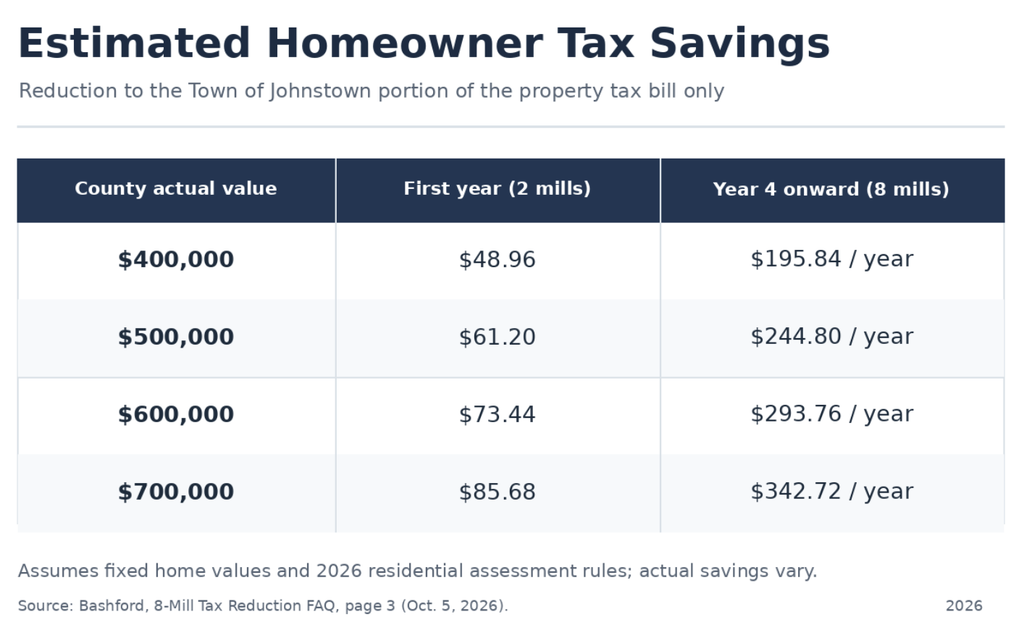
The estimates use Colorado’s 2026 residential assessment rate for local government levies and assume property values remain unchanged. Actual savings could differ because of future assessment rates, property valuations, and exemptions.
The proposal would affect only the Town of Johnstown’s portion of a property tax bill. Taxes collected by school districts, Weld or Larimer counties, fire districts, and other overlapping taxing authorities would remain unchanged.
The ordinance would also preserve the 3.3 mills currently dedicated to Johnstown’s Glenn A. Jones Memorial Library. The entire eight-mill reduction would instead come from the Town’s general operating levy, lowering that portion from 20.647 to 12.647 mills.
Businesses Would Also Receive Tax Relief
The proposed reduction would apply to commercial, industrial, agricultural, and other taxable properties, in addition to residential property.
Bashford’s calculations estimate that a commercial property with an actual value of $1 million would save approximately $500 in the first year and $2,000 annually after the full reduction, assuming a 25% commercial assessment rate and unchanged property values.
Businesses that lease commercial properties could also benefit when their lease agreements require them to pay property taxes. Whether those savings reach individual tenants would depend on their lease terms.
Bashford argues that a lower municipal mill levy could help Johnstown attract businesses and give existing employers additional financial flexibility. However, the proposal does not establish how much additional development, employment, or business investment might result.
Town Revenue Could Decline by Nearly $4.7 Million Annually
While property owners would pay less in municipal property taxes, the Town would also collect less revenue to support its operations and investments.
Using Johnstown’s preliminary assessed property valuation for 2027 and the budget’s assumed 98% collection rate, Bashford’s analysis estimates that annual property tax collections would decline by approximately $1.17 million in the first year compared with maintaining the current mill levy. The annual difference would increase as each additional reduction takes effect.
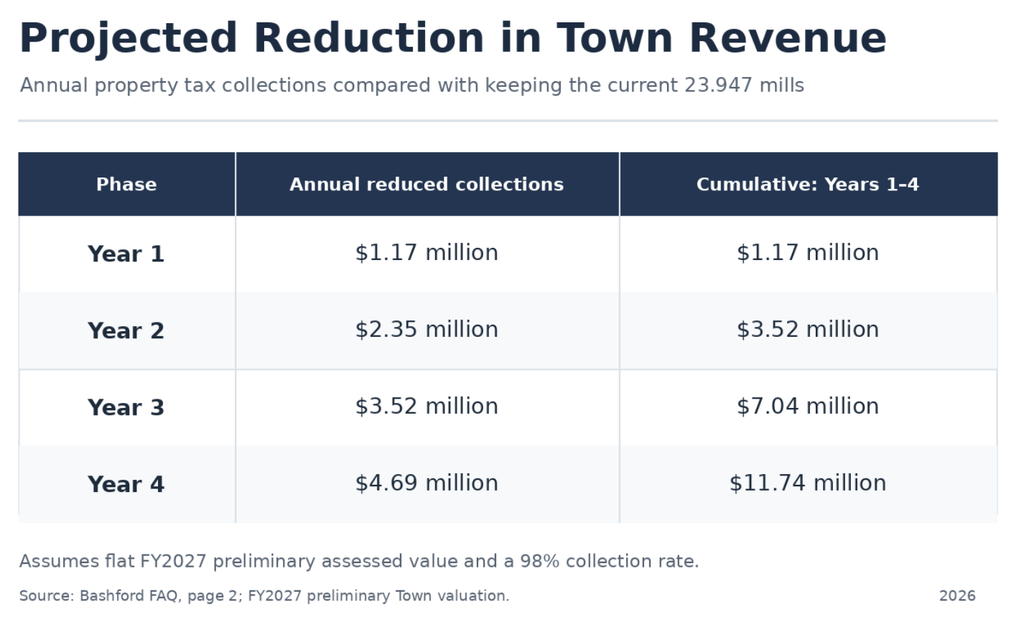
Over the first four years, the analysis projects approximately $11.74 million in cumulative reduced property tax collections. After full implementation, annual collections would be approximately $4.69 million lower than they would be under the existing mill levy, assuming the Town’s assessed property valuation remains unchanged.
The Town’s official agenda communication estimates approximately $11.9 million in reduced property tax collections over the first four years, using assumptions accompanying the proposal. Both estimates are projections, and actual collections will depend on property valuations, development activity, oil and gas production, and economic conditions.
These figures reflect projected reductions in revenue compared with maintaining the current levy. They do not represent an existing budget surplus or money already set aside for taxpayer refunds.
Town Staff Recommends Against the Permanent Reduction
In its six-page agenda communication, Town staff explicitly recommends against adopting Ordinance 2026-299, while acknowledging that the proposal would provide continuing financial relief to property owners.
Staff’s primary concern is that a permanent reduction would decrease a recurring revenue source used to support Town services, infrastructure, and community investments. The analysis also emphasizes that reducing the levy could limit the financial flexibility available to future Town Councils.
The document identifies several planned or potential investments that could require reevaluation, including the Public Works and Utility Facility, long-term water security, a future Police Department facility, and additional phases of Centennial Park development.
Other initiatives mentioned include trails and mobility improvements, equipment replacements, Downtown Development Authority initiatives, affordable housing, assisted living, and future staffing needs.
Staff does not conclude that any particular project would automatically be canceled. Instead, it states that a reduction could require Council to reconsider project timing, scope, funding strategies, or overall priorities.
The analysis also notes that property taxes generally provide a more predictable source of revenue than sales and use taxes, which fluctuate with consumer spending and development activity. Oil and gas property tax revenues are an exception because they can change significantly with production and assessed valuations.
Bashford Points to Reserves and Spending Adjustments
Bashford’s supporting documents present a different assessment of the Town’s ability to manage the proposed reduction.
His analysis identifies projected General Fund reserves of approximately $26.5 million at the end of 2027, equivalent to roughly 1.2 years of operating expenditures. The Town’s stated minimum reserve policy is approximately six months.
Bashford’s materials identify reserves, adjustments to capital spending, and future growth in the tax base as potential ways to accommodate reduced property tax collections. His analysis also acknowledges that reserves and delayed capital projects cannot, by themselves, permanently replace a recurring revenue source.
Under the proposed ordinance, the Town Manager and Finance Director would be directed to identify other lawful revenue sources or expenditure adjustments to address any resulting General Fund shortfall. The ordinance does not specify which projects or services would be reduced.
If the ordinance is adopted, Town staff estimates an initial revenue impact of approximately $1.2 million in the 2027 budget. According to the agenda communication, staff would prepare a revised proposed budget for presentation at the first November Council meeting, identifying expenditures or initiatives adjusted or removed to accommodate the reduction.
Town Staff Proposes Two Alternatives
Rather than permanently lowering the municipal mill levy, staff recommends considering either a temporary property tax credit or a property tax rebate program.
A temporary property tax credit would reduce the effective tax rate for a specified period while preserving the Town’s ability to return to its previously authorized rate in subsequent years. This would allow Council to reevaluate tax relief as financial conditions change.
A rebate program would allow the Town to collect property taxes at the established levy and subsequently return a portion to eligible property owners. Johnstown previously used this approach in 2024, providing approximately $650,000 in residential property tax rebates.
Staff argues that either approach would provide financial relief while preserving more flexibility for future budgets. Bashford’s proposal instead emphasizes permanent reductions that would not be reversed through ordinary annual budget decisions.
Johnstown’s Mill Levy Compared With Nearby Communities
Bashford’s supporting analysis also compares Johnstown’s municipal mill levy with nearby communities.
Using 2025 municipal mill levy figures, the analysis lists Johnstown’s current 23.947 mills above Windsor, Severance, Mead, Berthoud, Loveland, and Fort Collins. Among the neighboring communities included in the comparison, Fort Lupton and Milliken have higher municipal mill levies.
The analysis also ranks Johnstown second among 52 Colorado municipalities with populations of at least 10,000, behind Fort Lupton, based on the cited 2025 figures.
However, municipal mill levies do not necessarily reflect the total property tax burden in each community. Some municipalities fund services through separate special districts, different taxes, or other revenue sources, making direct comparisons more complicated.
For example, Johnstown includes 3.3 dedicated library mills within its municipal levy, while some neighboring communities fund library services through separate taxing districts.
Council to Consider Ordinance Monday
Johnstown Republic contacted Town Manager Matt LeCerf for comment on the proposal’s financial implications. LeCerf declined to comment ahead of Council consideration. Separately, the Town’s official agenda packet includes a staff analysis recommending against the permanent reduction.
The October 19 agenda materials include suggested motions to approve or deny Ordinance 2026-299 on first reading. Approval on first reading would not constitute final adoption, as the ordinance would still require a second reading and final approval before taking effect.
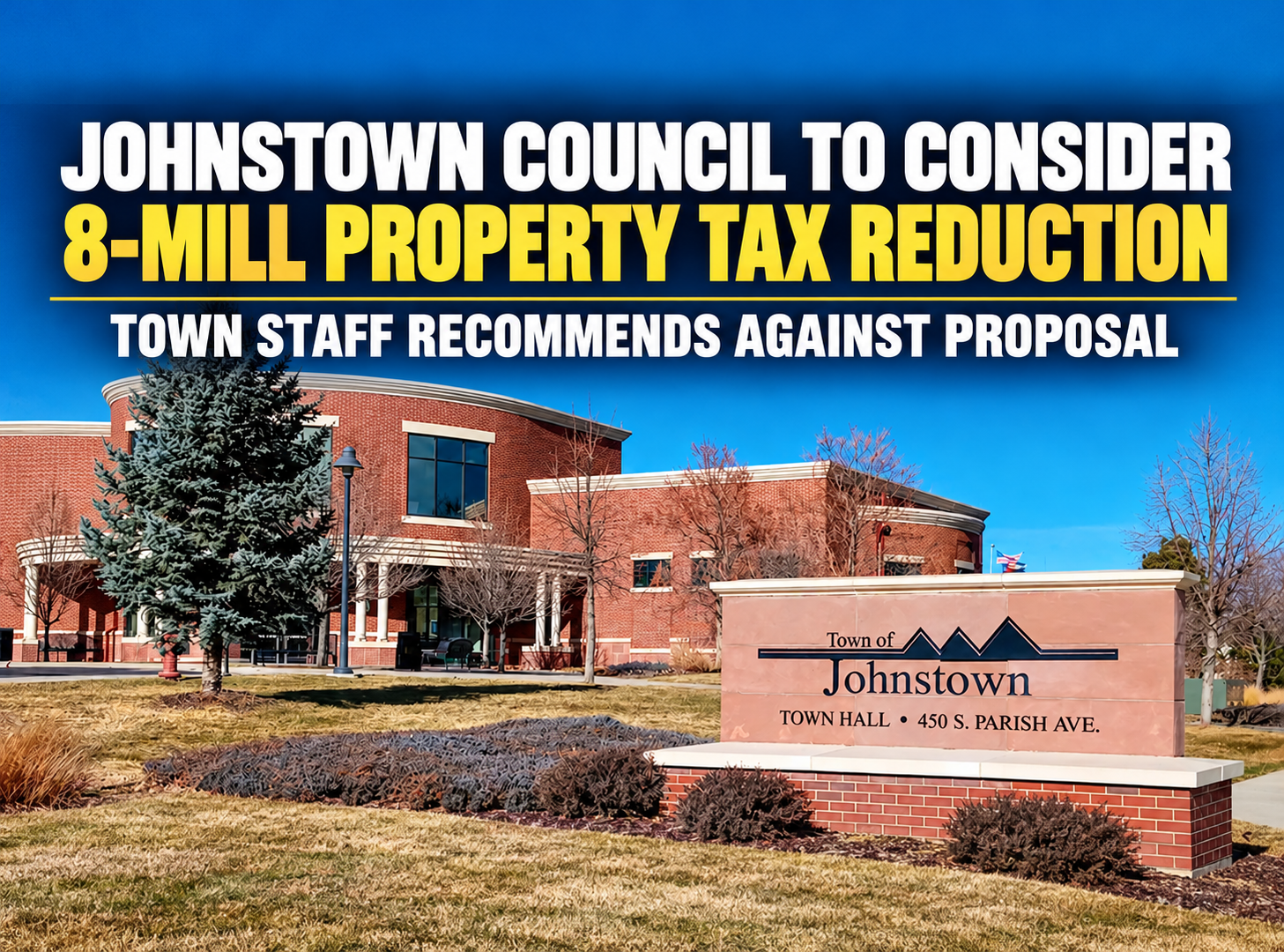
The Town Council meeting begins at 7 p.m. Monday, October 19, at Johnstown Town Hall, 450 S. Parish Avenue.
Residents can review the ordinance, Bashford’s supporting documents, and the Town’s financial analysis in the October 19 meeting packet. Information about watching meetings online and submitting public comments is available through the Town’s Agendas and Minutes page.
Johnstown Republic will continue following the proposal and report on Council’s discussion, any amendments, and the outcome of Monday’s consideration.