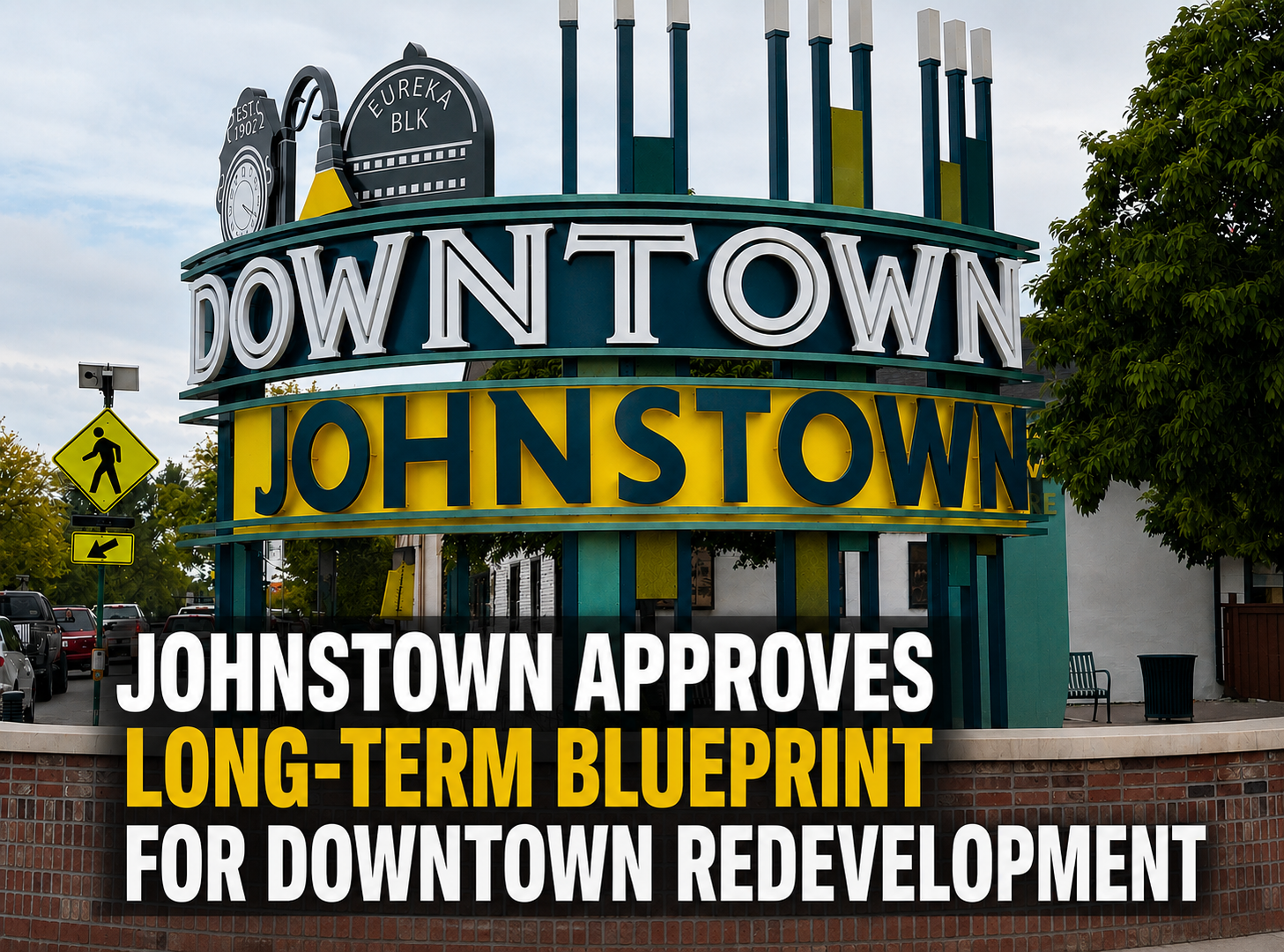
Johnstown has approved a long-term blueprint for downtown redevelopment that establishes priorities ranging from sidewalk and streetscape improvements in the historic downtown to potential major redevelopment projects over the next 10 to 20 years.
The Johnstown Town Council voted unanimously Monday, Aug. 17, to approve Resolution 2026-39 and adopt the Downtown Development Authority’s Plan of Development. All council members voted in favor. The Planning and Zoning Commission had previously recommended approval of the plan on Aug. 12.
The decision gives the recently established Downtown Development Authority, or DDA, the formal framework it will use to evaluate projects, establish annual priorities and direct future tax increment financing revenue toward downtown improvements. The Town describes the Plan of Development as the DDA’s guiding document, building on the Downtown Master Plan adopted in 2025.
Although the plan looks as far as 10 to 20 years into the future, its initial focus is much closer to the existing downtown core.
Historic Downtown Comes First
Historic Downtown, centered on Parish Avenue, is identified as the DDA’s highest near-term geographic priority. Early efforts are expected to concentrate on existing businesses, pedestrian infrastructure, streetscape conditions, parking and increasing activity downtown.
Among the plan’s initial priorities are completing the DDA’s organizational startup, transitioning functions previously handled by the Johnstown Downtown Development Association, improving sidewalks and streetscapes, increasing evening activity, attracting additional retail businesses and developing a parking-management strategy.
The plan also calls for the DDA to prepare for eventual development of the privately owned Rieder and Held properties, although those larger redevelopment areas are expected to play a greater role later in the authority’s timeline.
During its first two years, the DDA is expected to develop a more detailed action plan around those priorities. Potential early efforts include continuing business workshops and networking opportunities, recruiting retailers, identifying underused commercial space and encouraging businesses to experiment with longer evening hours.
The authority could also assume responsibility for established downtown events that have been organized by the Johnstown Downtown Development Association, including Cinco de Mayo, Fall Fest, Trick-or-Treat Street and the Johnstown Jingle, while coordinating with the Town on Johnstown BBQ Day.
Infrastructure improvements are another early focus. The plan calls for reviewing gaps in the downtown sidewalk network and coordinating with the Town and Colorado Department of Transportation on priorities for sidewalks and intersections. It also identifies inconsistent lighting as an issue and recommends developing a parking strategy aimed initially at encouraging employees and other long-term users to leave the spaces most convenient to downtown businesses available for customers.
More restrictive parking measures, such as time limits, could be considered later if education and voluntary parking-management efforts are not sufficient.
Larger Projects Could Take Years
The plan separates those relatively near-term initiatives from more ambitious projects that could require years of growth in DDA revenue, additional planning and cooperation with private property owners.
Within approximately five to 10 years, potential initiatives include additional murals and placemaking projects, a monthly farmers market and new events, work with property owners on the Rieder and Held properties, advancement of an Urban Farm concept and assistance with the proposed eastern extension of Charlotte Street through the industrial area.
The largest concepts generally fall into the plan’s 10- to 15-year-and-beyond timeframe. Those possibilities include development of the Urban Farm, redevelopment of the current JM Post property if the business relocates, additional infill development in Historic Downtown, a performing arts center on the Rieder property and construction of additional parking facilities if future demand warrants them.
Approval of the plan does not mean those projects have been approved for construction or that the DDA has committed money to build them. They are potential projects identified within a long-range framework, and their timing will depend on future funding, development activity, property-owner participation and decisions by the DDA Board.
That distinction is especially important for the Rieder and Held properties. The properties are privately owned and are not currently part of the DDA district. The Town has previously said those areas were included in downtown master planning to establish community expectations in advance of potential private development.
TIF Will Help Finance Future Improvements
A central component of the DDA is its ability to use tax increment financing, commonly known as TIF.
Johnstown voters within the DDA boundary approved creation of the authority and authorization of TIF during the April 7, 2026 election. Under the system, a base amount of property- and sales-tax revenue is established. As taxable property values and sales within the district grow above that base, a portion of the additional revenue can be captured and reinvested within the DDA.
The Town says TIF does not create a new tax or increase existing tax rates. Instead, it uses a portion of future growth in tax revenue generated within the district to support public improvements, infrastructure, redevelopment activities and other investments identified in the Plan of Development.
Johnstown’s plan identifies 2025 as the TIF base year and provides for both property- and sales-tax increment. Because the amount of available TIF revenue is expected to grow over time as economic activity and property values increase, the plan anticipates smaller programs and improvements during the DDA’s early years before potentially moving toward larger capital projects.
The DDA does not currently have an additional operating property tax. The plan notes that establishing an operating levy of up to five mills in the future would require Town Council approval and a separate TABOR election among eligible district voters.
From Master Plan to Implementation
The Plan of Development represents the next stage of a downtown planning effort that has been underway for several years.
Johnstown’s Downtown Master Plan established a broader vision for Historic Downtown, the nearby industrial area and the Rieder and Held properties. Among the issues identified through that process were sidewalk improvements, pedestrian safety, lighting, public spaces, parking, outdoor dining, retail and entertainment recruitment and better connections between downtown and future development.
The DDA now provides an organizational and financial mechanism for pursuing portions of that vision.
The Town says the DDA is governed by a seven-member Board of Directors responsible for overseeing implementation of the Plan of Development and advancing projects and partnerships intended to support downtown’s long-term economic vitality.
Monday’s unanimous Council vote does not determine exactly which project will be undertaken first or guarantee that every long-term concept in the plan will eventually be built. Instead, it establishes the framework the DDA can now use to move from organizational startup toward decisions about where its resources should be invested.
The plan recommends that it be reviewed and updated every five to 10 years, allowing priorities to change as downtown develops, funding becomes available and community needs evolve.