One of the year’s most anticipated meteor showers is approaching its peak, and Northern Colorado skywatchers could have unusually favorable astronomical conditions for watching it in 2026.
The Perseid meteor shower is expected to reach maximum activity overnight Wednesday, Aug. 12, into Thursday, Aug. 13. The American Meteor Society’s 2026 Meteor Shower Calendar lists the night of Aug. 12-13 as the shower’s peak and gives the Perseids a zenithal hourly rate of 100.
That number should not be interpreted as a guarantee that someone standing in a Johnstown backyard will see 100 meteors in an hour. The zenithal hourly rate is an estimate based on ideal observing conditions, including a dark sky and a favorably positioned radiant. Even so, 2026 offers one major advantage for viewers: the moon should not interfere with the peak.
When Is the Best Time to Watch?
The International Meteor Organization’s 2026 Meteor Shower Calendar places the expected Perseid maximum on Aug. 13 between 2 and 4 UTC, while also noting that the broader traditional maximum can occur over a longer period surrounding the peak.
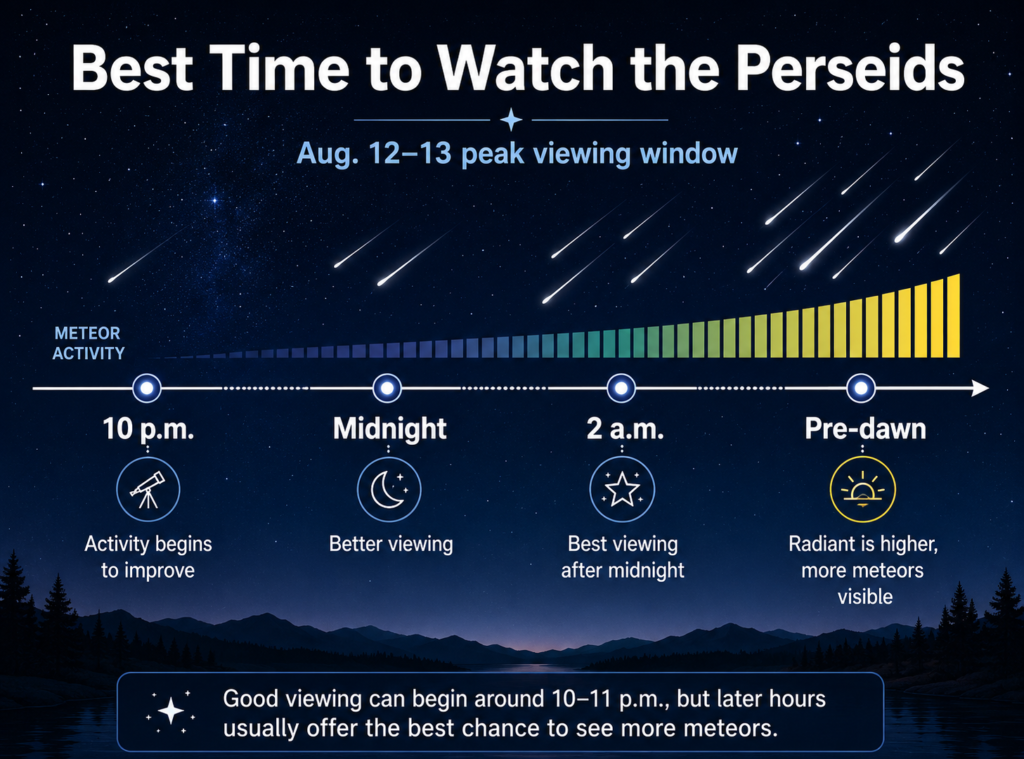
For Northern Colorado viewers, the practical advice is simpler. The best opportunity will be late Wednesday night, Aug. 12, continuing into the early morning hours of Aug. 13.
NASA says the Perseids are best viewed from the Northern Hemisphere during the pre-dawn hours, although meteors can sometimes be seen as early as 10 p.m. NASA’s Perseid viewing guide recommends finding a dark location and allowing time for the shower to develop as the night progresses.
The International Meteor Organization notes that the Perseid radiant reaches a reasonable elevation from roughly 10 to 11 p.m. local time at mid-northern latitudes, with conditions generally improving later in the night as the radiant climbs higher in the sky. For Johnstown-area residents who do not want to stay outside until dawn, heading out around 10:30 or 11 p.m. should still provide an opportunity to see activity. Those willing to stay up after midnight and into the early morning will generally have a better chance of seeing more meteors.
A New Moon Could Make 2026 an Excellent Year
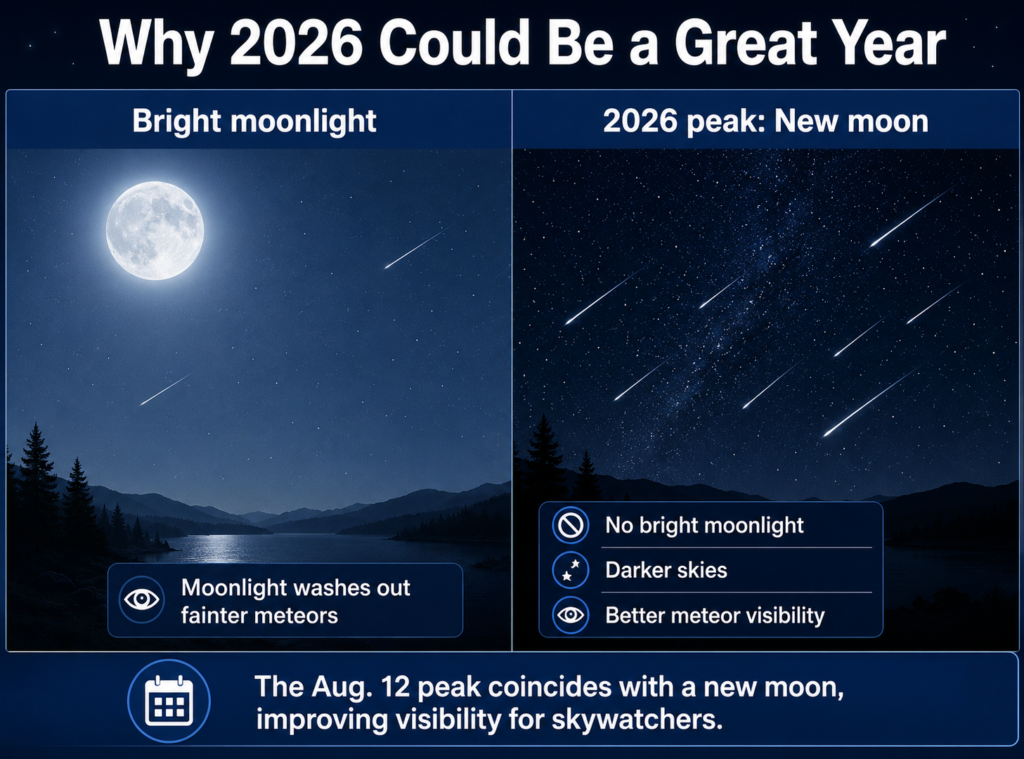
The timing of the moon is one reason this year’s Perseid peak is receiving added attention. A new moon occurs Aug. 12, the same day the shower approaches maximum activity, and the International Meteor Organization describes the lunar conditions as excellent for optical observations of the Perseids.
During years with a bright moon, moonlight can wash out fainter meteors and reduce the number visible to the naked eye. This year, observers should have a much darker natural sky during the peak, making it easier to see dimmer meteors that might otherwise be lost in the moon’s glow.
That does not mean every meteor will be visible from Johnstown. Streetlights, neighborhood lighting, vehicle headlights and the broader glow from nearby communities can still obscure fainter meteors. In general, the darker the location, the more of the shower an observer is likely to see.
Where Should Johnstown Residents Watch?
Residents may still see brighter Perseid meteors from their own yards, especially in neighborhoods with fewer nearby lights. Turning off exterior lighting and moving to the darkest part of a property can improve viewing conditions without requiring a drive.
For better conditions, observers should consider moving away from the concentrated lights of Johnstown, Interstate 25 and larger Northern Colorado communities. Wide-open areas with a broad view of the sky and limited nearby lighting will generally offer a better experience.
One potential option for those willing to make a longer drive is the Pawnee National Grassland in eastern Weld County. The U.S. Forest Service manages approximately 193,000 acres within the grassland area northeast of Greeley.
Anyone considering the grassland should plan carefully before driving there at night. The Forest Service warns that land ownership in the area follows a checkerboard pattern of federal, state and private property, meaning much of the land within the broader grassland boundaries is privately owned. The agency provides Motor Vehicle Use Maps and visitor maps to help visitors identify National Forest System roads and legal access.
Observers should not assume an empty field or rural roadside is public property. They should remain on legally accessible land, avoid blocking roads or gates and check current Forest Service road information before leaving.
For those staying closer to Johnstown, the goal is not necessarily to find a named park. Many parks and open spaces have nighttime closure rules, so a legal and safe location away from direct lighting with a broad view of the sky may be a better option.
Which Direction Should You Look?
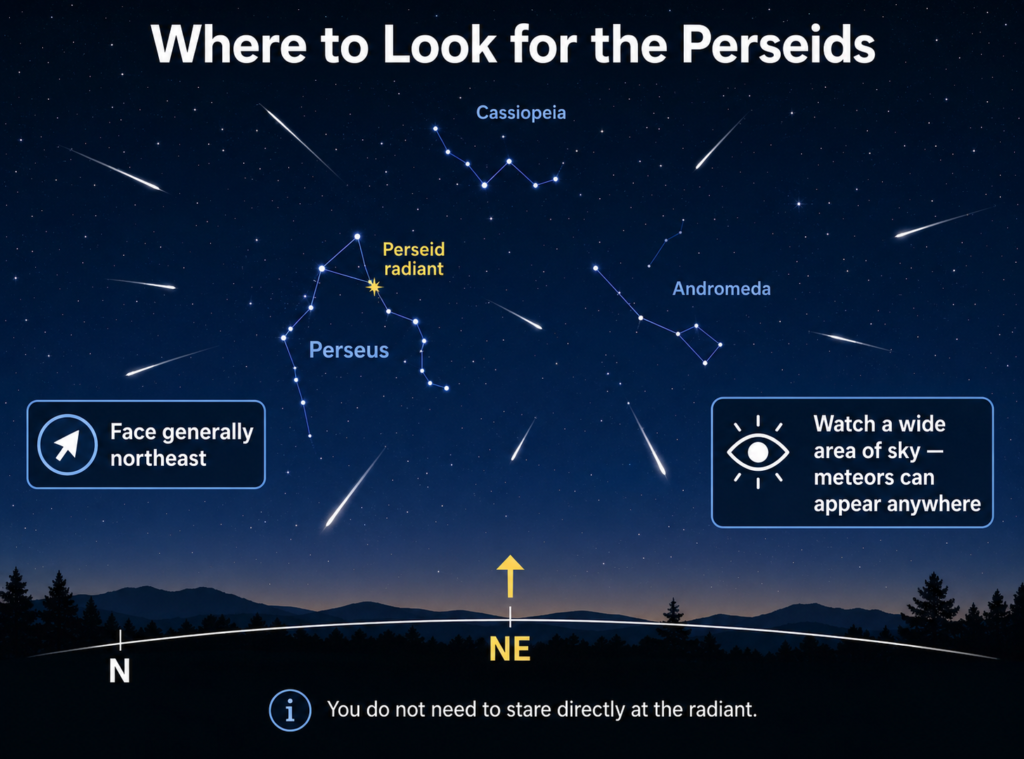
The Perseids appear to radiate from the general direction of the constellation Perseus, which is where the meteor shower gets its name. NASA notes that the shower’s radiant rises in the northeast, making that a useful general direction to face when beginning to watch.
There is no need to stare directly at Perseus, however. Perseid meteors can appear across large portions of the sky, so keeping as much of the sky in view as possible is more useful than focusing on one small area.
A reclining lawn chair or blanket can make it easier to look upward for an extended period. A telescope is also unnecessary and can actually limit the field of view, making meteor watching primarily a naked-eye activity.
Give Your Eyes Time to Adjust
One of the easiest ways to improve meteor viewing costs nothing: allow your eyes time to adjust to the darkness.
The National Park Service says the human eye can take 20 to 30 minutes to fully adjust to very low light conditions. Bright phone screens, white flashlights and vehicle lights can interrupt that adjustment. National Park Service stargazing guidance recommends using a red light when illumination is necessary because it has less effect on night vision.
Observers should bring a chair or blanket, settle in and plan to stay outside for more than a few minutes. Meteor showers often include quiet stretches followed by several visible meteors over a shorter period, so patience can make a significant difference in the experience.
Will the Weather Cooperate?
While the astronomical conditions for the 2026 Perseids are unusually favorable, the weather forecast for Northern Colorado is becoming less certain. As of Monday, Aug. 10, the forecast for Johnstown calls for a hot Wednesday with a chance of afternoon thunderstorms. By Wednesday evening, skies are currently expected to be cloudy to mostly cloudy, which could interfere with views of the meteor shower if those conditions persist into the overnight hours.
That does not necessarily mean the Perseids will be a washout. Northern Colorado weather can change quickly, and breaks in the clouds could still provide viewing opportunities Wednesday night and early Thursday morning. The forecast may also shift as the peak gets closer.
Smoke is another potential concern. Smoke and haze have been present across parts of Northern Colorado this weekend, although conditions several days ahead remain uncertain. Even without thick cloud cover, wildfire smoke or haze can make fainter meteors more difficult to see.
Residents planning to watch should check the latest hourly forecast and sky conditions Wednesday evening before driving to a darker viewing location. If skies clear, the underlying astronomical setup remains excellent: the Perseids will be near maximum activity with essentially no moonlight competing with the shower. If clouds remain widespread, however, local viewers may have fewer opportunities to take advantage of those otherwise favorable conditions.
For the best opportunity, mark the night of Aug. 12 into the early morning of Aug. 13 and keep an eye on the local forecast. If skies cooperate, find a dark and legal viewing location, give your eyes time to adjust and keep as much of the sky in view as possible. The moon will not be a significant obstacle this year, but clouds and smoke may ultimately determine how much of the Perseid peak Northern Colorado residents are able to see.