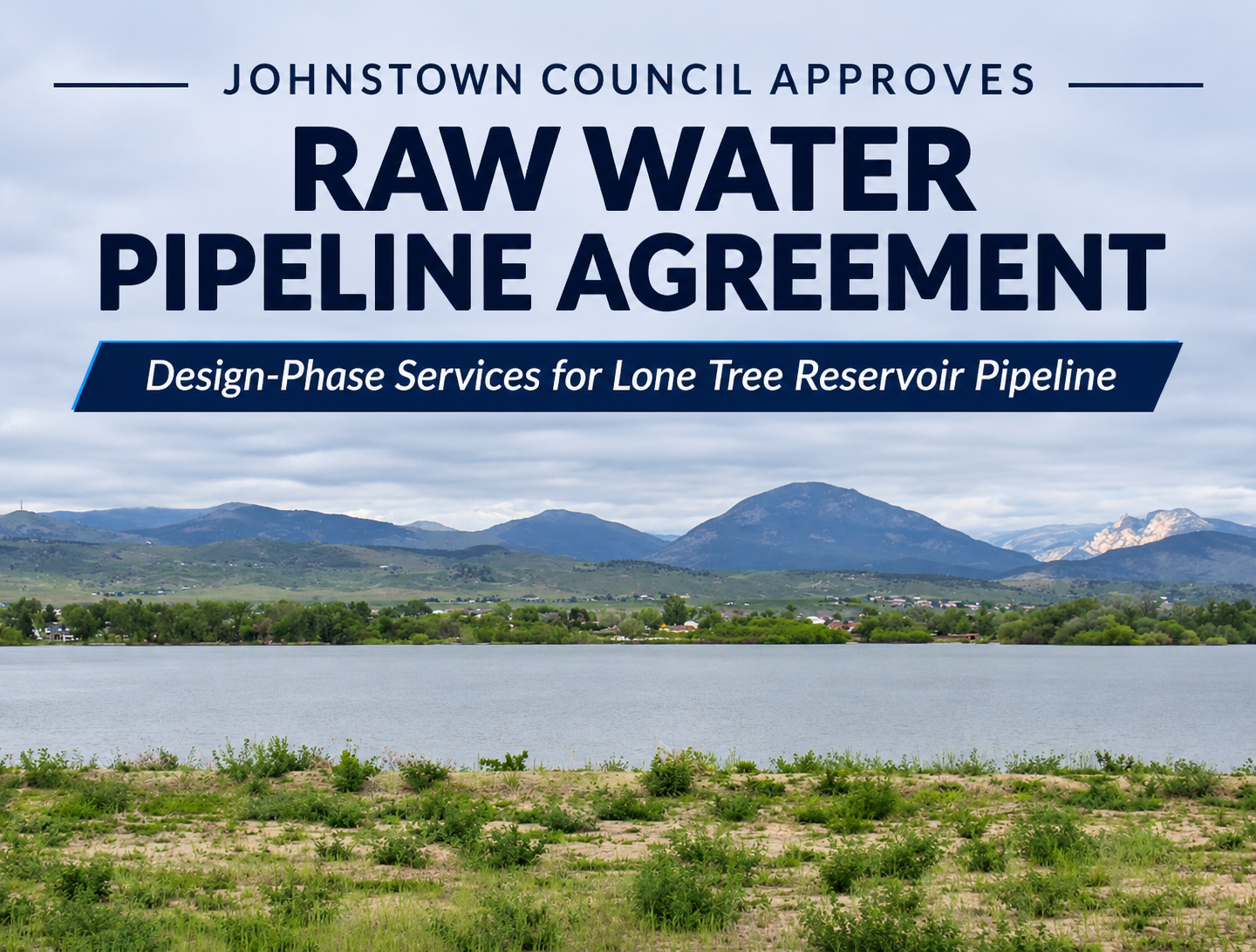
JOHNSTOWN, Colo. — The Johnstown Town Council approved a $150,645 professional services agreement with Connell Resources Inc. on November 2, advancing plans for an approximately 11-mile raw water transmission pipeline connecting Lone Tree Reservoir to the town’s water treatment plant. The council also authorized up to $20,000 for additional services, bringing the total potential expenditure under the agreement to $170,645.
The agreement covers construction management services during the project’s design phase, rather than construction of the pipeline itself. The proposed infrastructure is intended to increase the amount of untreated water delivered to Johnstown’s treatment facility, supporting the town’s ongoing expansion of its municipal water system.
The agreement appeared as Item 8 on the November 2 Town Council agenda. The council’s approval and contract amounts were also documented in reporting on the meeting.
An 11-Mile Pipeline to Support Water Treatment Expansion
According to the Town of Johnstown’s official project overview, the project includes approximately 11 miles of 30-inch-diameter pipeline designed to transport raw water from Lone Tree Reservoir to the town’s water treatment plant. Plans also include a new pump station to move water through the transmission system.
The pipeline is intended to complement the town’s water treatment plant expansion, which is designed to increase treatment capacity to 12 million gallons per day, with an ultimate planned capacity of 21 million gallons per day.
While expanding the treatment plant will increase the amount of water Johnstown can process, additional transmission infrastructure is also needed to deliver sufficient untreated water to the facility. The proposed pipeline is intended to address that need and improve the reliability of the town’s raw water delivery system.
The project has been in development for several years. Town records indicate that Civil Resources began working with Johnstown on engineering and route planning in 2022. Since then, the town has continued developing construction plans, negotiating property easements and coordinating necessary approvals.
What Connell Resources Will Do
Connell Resources was selected through a competitive procurement process to provide construction manager at risk services, commonly referred to as CMAR.
Under this approach, a contractor becomes involved before construction begins to help evaluate construction methods, scheduling, cost estimates and potential challenges. The process allows the contractor and engineering team to coordinate during design before a final construction price is established.
The town’s July 2026 request for proposals sought a contractor capable of providing design-phase services and potentially continuing into construction. Connell was recommended following an evaluation of contractor qualifications, proposals and interviews.
Connell’s proposal includes a partnership with Moltz Construction Inc. for the pump station portion of the project. The selection process considered the firms’ experience, proposed approach and ability to perform the work.
Under the approved agreement, Connell will receive $150,645 for design-phase construction management services. The council also authorized the town manager to spend up to an additional $20,000 on supplemental services if needed.
The agreement does not establish a final construction price. According to the town’s project information, Johnstown intends to proceed with its selected contractor for construction if the parties reach an agreement on a guaranteed maximum price, or GMP.
That future agreement would represent a separate financial commitment from the design-phase services approved November 2.
Construction Expected to Begin in 2027
Construction is now anticipated to begin in early 2027, with substantial completion targeted for spring 2029, according to information presented during the November 2 council meeting.
The schedule represents a change from earlier projections. The town’s published project overview previously anticipated construction beginning before the end of 2026, but engineering work, property access arrangements and regulatory coordination have continued as the project moves toward construction.
Three property easements remained outstanding at the time of the council meeting, according to meeting coverage. Easements establish legal rights to use portions of private property for infrastructure construction, operation and maintenance.
The town’s official project updates indicate that easements in Weld County have been completed, while remaining property arrangements in Larimer County are still being addressed. The town also identifies Larimer County technical review as part of the project’s remaining preparation.
The anticipated construction timeline remains subject to completion of those requirements and agreement on construction pricing.
Project Funding and Costs
The raw water transmission project is financed through Johnstown’s Water Fund, an enterprise fund used to support water utility operations, infrastructure maintenance and system expansion.
The November 2 authorization includes $150,645 for Connell’s design-phase services and up to $20,000 in additional expenditures. Those amounts represent a portion of the larger infrastructure project and should not be confused with the total cost of constructing the pipeline and pump station.
Johnstown’s project overview identifies the Water Fund as the project’s financing source but does not provide an updated final construction cost.
The town will need to establish construction pricing before proceeding under the proposed CMAR arrangement. The final cost could depend on factors including construction methods, materials, property access, permitting requirements and the completed project design.
The council’s November 2 decision does not itself approve a final construction contract or establish any change to residential water rates.
What the Agreement Means for Johnstown
The raw water pipeline is another component of Johnstown’s efforts to expand municipal water infrastructure as the community continues to grow.
Water rights establish the town’s legal entitlement to use water, while transmission and treatment infrastructure allow that water to be delivered and processed for municipal use. The proposed pipeline is intended to strengthen that connection by providing additional raw water delivery capacity to the expanded treatment facility.
For residents, the project’s long-term purpose is to support water system capacity and reliability. However, the benefits depend on completing the transmission infrastructure and integrating it with the town’s existing water system.
The November 2 approval moves the project further through its planning and design process without committing the town to a final construction price. Remaining steps include completing outstanding easements, addressing applicable reviews and negotiating construction costs before work proceeds.