Update — Sept. 16, 2026: Recall organizers submitted 559 signatures by the Sept. 15 deadline. Town Clerk Meghan Martinez said the Clerk’s Office has five business days to review the petitions and determine whether at least 490 signatures are valid. Under C.R.S. § 31-4-503, if the petition is deemed sufficient, the process may move toward an election unless a protest is filed.
A petition seeking the recall of Johnstown Mayor Michael Duncan is being circulated in Johnstown, but a Johnstown Republic review of the records underlying the petition found important distinctions between several of its allegations and the formal actions documented by the Town.
The Town Clerk’s Office received the recall petition on July 16, 2026, and determined on July 17 that it was sufficient as to form for circulation. Recall organizers must submit at least 490 valid signatures from registered Johnstown electors by 5 p.m. Sept. 15 for the process to continue.
The Clerk’s determination allowed the petition to circulate. It was not a finding that the allegations against Duncan were true or that he violated the Town Charter. The Clerk also made clear that no determination had yet been made regarding the sufficiency of signatures.
The approved petition accuses Duncan of “exceeding his authority under the Town Charter” and “undermining transparency in Town governance.” Much of the case presented by recall organizers centers on a proposed 2025 consulting agreement with Russ Baca, Duncan’s continued support for artificial intelligence and data-infrastructure development after Council rejected that agreement, and a July 2026 Town Council work session concerning data-center policy.
Duncan disputes the allegations. In a written response to the Johnstown Republic, he said he advocated for proposals and supported bringing issues before Council but did not independently exercise governmental powers reserved for the Council or Town administration.
“I did not award Mr. Baca a contract. I did not execute a contract. I did not create an office. I did not appropriate Town money. I did not procure land,” Duncan said.
READER DOCUMENT
Approved Recall Petition — July 17, 2026
Read the recall petition approved for circulation by the Johnstown Town Clerk’s Office.
Council rejected Baca agreement, not broader data-center development
The dispute dates to Sept. 3, 2025, when the Town Council considered a proposed professional-services agreement with Baca for Medical AI-related economic-development work.
A Town Council agenda communication described the proposal as a request from Duncan to develop and enter into an agreement with Baca for economic-development services “related exclusively to Medical AI.” The proposed agreement would have paid Baca $3,500 per month and made him eligible for a $10,000 bonus if his work resulted in recruitment of a qualifying Medical AI business meeting specified investment, employment and facility requirements.
The formal agreement placed limits on Baca’s proposed authority. It stated that the Town would exclusively negotiate any incentives offered by Johnstown and that Baca had no authority to bind the Town. Expenses required prior written authorization from the Town Manager, and Baca would not be entitled to a real-estate commission unless a separate agency agreement was executed.
Baca’s accompanying cover letter described a broader possible role that included negotiating and arranging real-estate transactions and building partnerships with healthcare providers, developers and technology companies. Town staff, however, specifically advised Council that the broader services described in the cover letter were not part of the formal contract unless Council chose to add them.
Council ultimately voted 5-1 to deny the professional-services agreement, with Duncan casting the sole vote against denial.
That distinction is important because the recall petition later characterizes Duncan’s continued support for data-center policy as occurring “despite Council’s prior denial.” The formal Sept. 3 action was a denial of the specific Baca professional-services agreement. The Johnstown Republic has not identified a separate motion, resolution or ordinance from that meeting prohibiting Johnstown from considering AI or data-center development more broadly.
Duncan said he understood the vote as applying to the contract itself.
“I understood the vote as a decision on that contract,” Duncan said. “I did not treat it as a ban on Council discussing the subject again.”
Council discussion also included concerns about selecting a particular consultant without first conducting a broader competitive process.
READER DOCUMENT
Proposed Professional Services Agreement with Russ Baca
The proposed agreement considered by Council on Sept. 3, 2025. The copy reviewed by the Johnstown Republic contains unsigned signature lines.
Town policy did not require mandatory bidding for Baca agreement
The absence of a Request for Proposal became one of the criticisms surrounding the proposed Baca agreement and is cited by recall organizers as part of their argument that Duncan bypassed established processes.
The Town’s Comprehensive Financial Management Policies in effect in September 2025, however, expressly exempted professional services from mandatory public bidding.
The policy states that its public-bidding requirements “shall not be mandatory in the employment of professional services.” It specifically lists consultants and real-estate brokers among the professional services covered by that exemption and says Council may award those services at its discretion.
The same policy includes procedures for Requests for Proposals and Requests for Qualifications when the Town chooses to use them, and it says an RFQ process is often used for professional services. But the professional-services exemption meant a competitive RFP or RFQ was not a mandatory prerequisite to Council considering Baca’s agreement.
That does not mean councilmembers could not prefer a competitive process or believe one would have been better policy before selecting Baca. It does mean that, under the Town policy then in effect, an RFP or other public-bidding process was not mandatory for the professional-services agreement.
READER DOCUMENT
Town of Johnstown Comprehensive Financial Management Policies — April 2022 — Page 25 Section 12 (a): Exemptions From Public Bidding
See the Purchasing Policies section, particularly “Exemptions From Public Bidding,” which addresses professional services, consultants and real-estate brokers.
Duncan continued publicly promoting AI and data infrastructure
The public record does support an important part of the recall organizers’ account: Duncan continued advocating for artificial intelligence and data-infrastructure development after the Baca agreement was rejected.
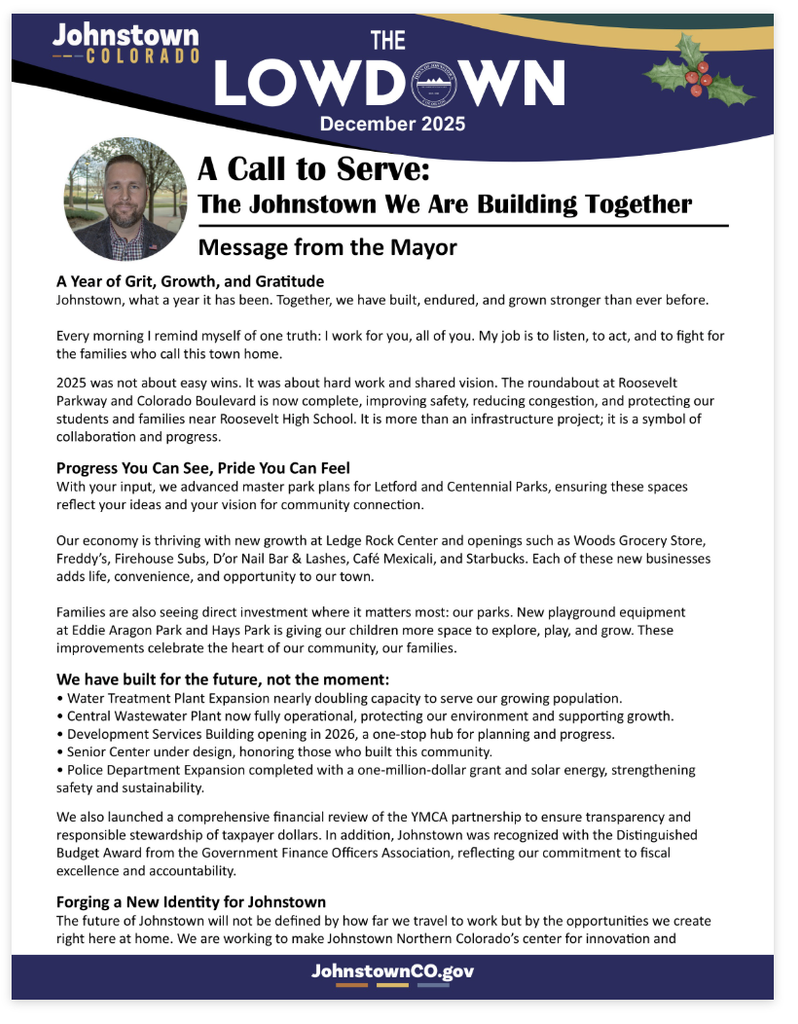
In the December 2025 edition of the Town’s Johnstown Lowdown, Duncan wrote:
“We are working to make Johnstown Northern Colorado’s center for innovation and technology.”
He continued by specifically referring to attracting “Artificial Intelligence and data-infrastructure industries” as part of an effort to create higher-paying jobs in Johnstown.
The question, therefore, is not whether Duncan continued supporting AI and data-infrastructure development. He did.
The dispute is whether continuing to advocate for those industries after Council rejected Baca’s contract amounted to disregarding Council or exceeding the authority of the mayor.
The Johnstown Republic identified no Council motion, resolution or ordinance prohibiting further consideration of AI or data-center policy.
READER EVIDENCE
December 2025 Johnstown Lowdown — Mayor’s Column
In his December 2025 column, Duncan wrote that Johnstown was working to become a Northern Colorado center for innovation and technology and specifically referenced AI and data-infrastructure industries.

July work session brought data-center policy before the full Council
The recall petition also points to a July 13, 2026 Town Council work session, alleging Duncan “again directed staff to prepare a data center concept despite Council’s prior denial.”
Duncan acknowledges supporting the return of the issue to Council.
“I supported bringing data center policy before Council for public discussion and education,” he told the Johnstown Republic. “I supported that work session and I am not walking it back.”
The official July 13 work-session packet describes the meeting as a broad policy discussion presented to the full Town Council, rather than consideration of a specific proposed data center.
The staff memorandum said its purpose was to provide Council with information and “solicit feedback on the direction Council would like staff to take regarding the development of a policy for the attraction and development of data centers within the Town.”
Council was asked to consider whether data centers should be permitted, prohibited or allowed through a special-review process; whether Johnstown should establish a specific land-use classification; which zoning districts might be appropriate; what development standards should apply; and whether the Town should consider economic-development incentives.
The presentation also identified a regulatory issue facing the Town. Johnstown’s Land Use Development Code did not specifically define data centers. Staff said that, under the existing code at the time, a data-center application could be processed as “Warehouse with Indoor Storage” through a Use by Special Review in qualifying industrial districts.
The July 13 packet does not document approval of a particular data-center project, site, development agreement, incentive package or expenditure. Instead, it documents Town staff presenting information and asking the full Council for direction on future policy.
That is a materially different action from the Sept. 3, 2025 vote denying Baca’s consulting agreement.
READER DOCUMENT
July 13, 2026 Data Center Presentation
July 13, 2026 Town Council Communication
The full staff memorandum and presentation provided to Town Council during the July 13 data-center policy work session.
Charter violation has not been independently established
The central allegation in the recall petition is that Duncan exceeded the authority granted to the mayor under Johnstown’s Home Rule Charter.
The petition points to the Charter provisions making the mayor a member of Council with the same voting authority as other councilmembers and identifying the mayor as the head of Town government for ceremonial and political purposes. Recall organizers contend Duncan’s involvement in the Baca proposal and subsequent AI and data-center efforts went beyond those limits.
Duncan argues that the Charter distinguishes political advocacy from official governmental action. He cited Charter provisions governing Council action, contracts and expenditures and said advocating for an issue or asking Council to consider it does not itself commit the Town.
The Baca proposal was brought before Council and rejected. The proposed agreement reviewed by the Republic contains unsigned signature lines. No executed version of that agreement has been identified in the records reviewed for this article.
The Republic also has not identified a court ruling, publicly available Town Attorney opinion, ethics finding or other independent legal determination concluding that Duncan violated the Charter through the Baca proposal or subsequent data-center policy discussions.
Duncan said he was never advised by the Town Manager, Town Attorney or Town Council that his actions concerning Baca, AI initiatives or data-center policy exceeded his authority.
That statement is Duncan’s account. The Republic has not independently reviewed any privileged legal advice that may have been provided to Town officials.
Clerk approved petition form, not its allegations
Town Clerk Meghan Martinez’s July 17 correspondence draws an important distinction between approving a recall petition for circulation and deciding whether the accusations contained in it are true.
The Clerk determined that the petition was sufficient as to form. The recall committee was then given 60 days to gather at least 490 valid signatures from registered Johnstown electors.
The Clerk’s letter does not make a factual or legal finding regarding the allegations against Duncan.
A separate notification sent to Duncan likewise said the petition was sufficient for circulation and that no determination had been made regarding the sufficiency of signatures.
Duncan emphasized the same distinction in his response to the Republic.
“The Town Clerk’s July 17 determination permitting the recall petition to circulate should not be confused with a finding that the allegations are true or that I violated the Charter,” Duncan said.
READER DOCUMENT
Town Clerk’s Petition Sufficiency Letter to Recall Committee
The July 17 letter confirming that the petition was sufficient as to form and setting the requirement of at least 490 valid signatures by Sept. 15.
Republic sought additional documentation from recall committee member
The Johnstown Republic contacted Pauline Migliore, one of three committee members named on the approved recall petition, seeking records or other documentation supporting several disputed claims, including the alleged Charter violation, the characterization of Council’s September 2025 vote as a broader rejection of data-center development, the RFP criticism and the description of Baca’s proposed role.
Migliore had not responded as of publication.
The lack of a response does not establish that the committee’s claims are incorrect. Where the petition’s characterizations are disputed, the Republic has relied on the official petition, Town meeting records, contracts, policies and other primary-source documents available for review.
Recall effort remains active
The recall committee has until 5 p.m. Sept. 15 to submit at least 490 valid signatures to the Town Clerk. If organizers submit the petition by the deadline, the Clerk will make an initial determination of whether it is sufficient. Under C.R.S. § 31-4-503(3)(b), a registered elector of the municipality may file a written protest under oath within 15 days after the petition is filed, including challenges involving the petition, circulator affidavits or compliance with statutory requirements. If a protest is filed, a hearing is held before the municipal clerk or another designated hearing officer. The officer sought to be recalled, the officer’s representative, or a majority of the recall committee may then seek district-court review of the hearing officer’s determination.
The records reviewed by the Johnstown Republic confirm that Council rejected the proposed Baca consulting agreement, Duncan continued publicly advocating for AI and data infrastructure afterward, and data-center policy returned to the full Council for discussion in July 2026.
Those records also show important distinctions between those events and several characterizations contained in the recall petition. Whether the allegations ultimately justify removing Duncan from office is a decision Johnstown voters may be asked to make if organizers gather enough valid signatures to advance the recall.
Update — Sept. 11, 2026: This article was updated to clarify the recall process after petitions are submitted, including the statutory protest period, hearing process and potential district-court review under Colorado law. No other substantive changes were made.