
Today marks the 119th anniversary of Johnstown’s incorporation, a milestone that offers an opportunity to celebrate the community’s history and reflect on the events and people that shaped its founding. Officially incorporated on May 13, 1907, Johnstown has grown from a small agricultural settlement into one of northern Colorado’s fastest-growing communities, yet many of the forces that shaped the town in its earliest years remain central to its identity today.
That anniversary also offers a reason to look beyond the date itself. Johnstown’s story did not begin in 1907, but in the years before incorporation, when agriculture, rail transportation, and the ambitions of one pioneer family helped give rise to a new town on Colorado’s Front Range.
The Parish Family and the Founding of Johnstown
Johnstown’s origins are closely tied to Harvey J. Parish, an entrepreneur and early settler credited with establishing the townsite in 1902. At the time, Weld County and the surrounding region were undergoing rapid agricultural expansion fueled by irrigation development and the increasing viability of farming on the plains. Rail lines and agricultural commerce were creating opportunities for small communities to emerge, and Parish recognized the potential for a town in this growing corridor.
Historical records indicate Parish platted the settlement in 1902, and the community took the name Johnstown after his son, John Parish. Local historical accounts hold that John came west in poor health, reportedly seeking the restorative climate that drew many to Colorado during that period. The story of John’s recovery became part of local lore, intertwining the identity of the town with the family that helped establish it. That connection continued in civic leadership as well: Harvey Parish is credited as Johnstown’s first mayor, while John Parish later served as mayor from 1929 to 1934, an uncommon generational link between a town’s founding and its later governance.
Why the Railroad Mattered
Johnstown may have been platted in 1902, but a town on paper does not become a thriving community without economic lifelines. One of the most important of those lifelines was the railroad. A historic photograph preserved by the Denver Public Library shows residents gathered in 1902 to celebrate the arrival of the first Great Western Railway Company train into town, a moment that represented much more than the arrival of transportation.
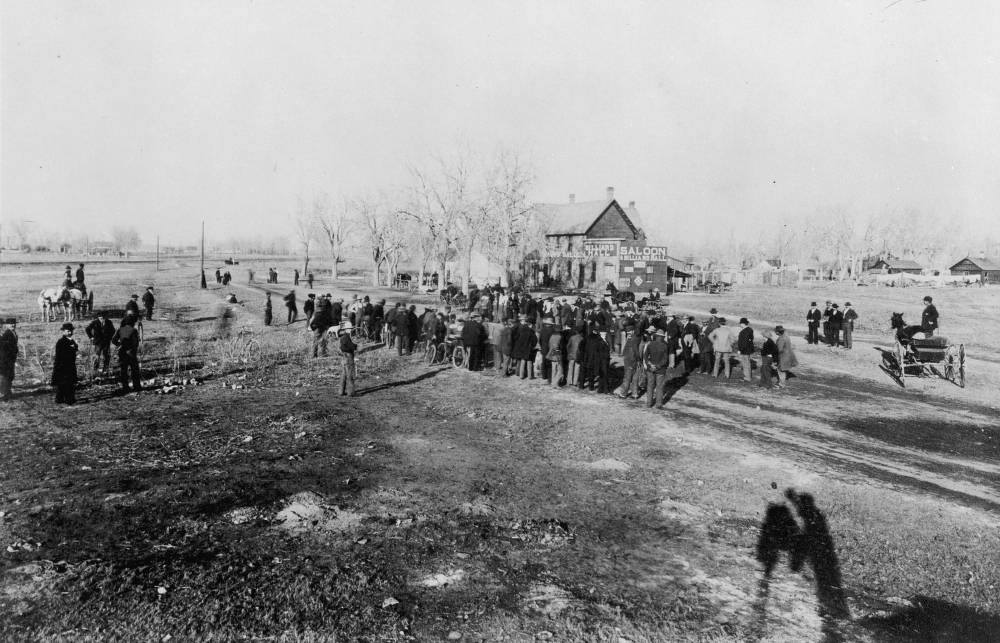
Community members wait for the first Great Western Railway train to arrive in Johnstown in 1902. Photo courtesy of the Denver Public Library, Western History Collection.
Rail access connected Johnstown to regional markets, enabled agricultural goods to move efficiently, and linked the young settlement to broader economic systems essential for long-term growth. For communities across Colorado’s Front Range, railroads often determined whether a settlement would prosper or fade. In Johnstown’s case, the railroad helped establish the town as a viable commercial and agricultural center.
The railway also tied Johnstown into northern Colorado’s expanding sugar beet economy, which became a defining force in the region’s development in the early twentieth century. Beet farming and the transportation networks that supported it brought labor, commerce, and permanence to many communities, including Johnstown. Agriculture was not simply background to the town’s early years; it was the economic foundation on which much of its growth rested.
Incorporation in 1907
By the time incorporation came on May 13, 1907, Johnstown had moved beyond frontier settlement into an organized municipality. Incorporation granted legal standing, established local governance, and provided a framework for managing growth and public affairs. Across Colorado, incorporation often marked the transition from informal settlement to structured civic life, and Johnstown followed that pattern.
One surviving reminder of that formative era remains visible in the historic Eureka Block, built in 1907 and still standing downtown. The date on its façade serves as more than architectural ornament; it marks a moment in the town’s development when Johnstown moved from aspiration into institution.
Growth Beyond the Founding Era
Although founded in agriculture and shaped by rail, Johnstown did not remain static. Like many northern Colorado communities, it evolved through changing agricultural patterns, transportation corridors, and later regional growth pressures tied to the expanding Front Range. What began as a rural settlement eventually developed into the growing municipality residents know today.
Yet many of the forces that shaped the town in its earliest years — land, water, transportation, and civic leadership — continue to influence its identity. That continuity makes Johnstown’s history more than a collection of dates or anniversaries. It is a story of how geography, infrastructure, and people combined to create a lasting community.
Why This History Matters
As Johnstown marks 119 years since incorporation, the anniversary serves as more than a ceremonial milestone. It offers an opportunity to reflect on the people who founded the town, the infrastructure that sustained it, and the civic decisions that helped shape its future. In a community experiencing rapid growth today, understanding those origins provides an important perspective.
Behind the town’s name is the story of a family. Behind its growth was a railroad and an agricultural economy. Behind incorporation was a community already taking shape through effort and opportunity. Modern Johnstown rests on those foundations, and anniversaries such as this offer a reminder that the town’s past remains part of its present.
Editor’s Note
Some historical references connect 1904 with Johnstown’s early organization, while commonly cited municipal and county records identify May 13, 1907, as the town’s official incorporation date.
Sources
- Denver Public Library
- Weld County Historical Society
- Town of Johnstown historical materials