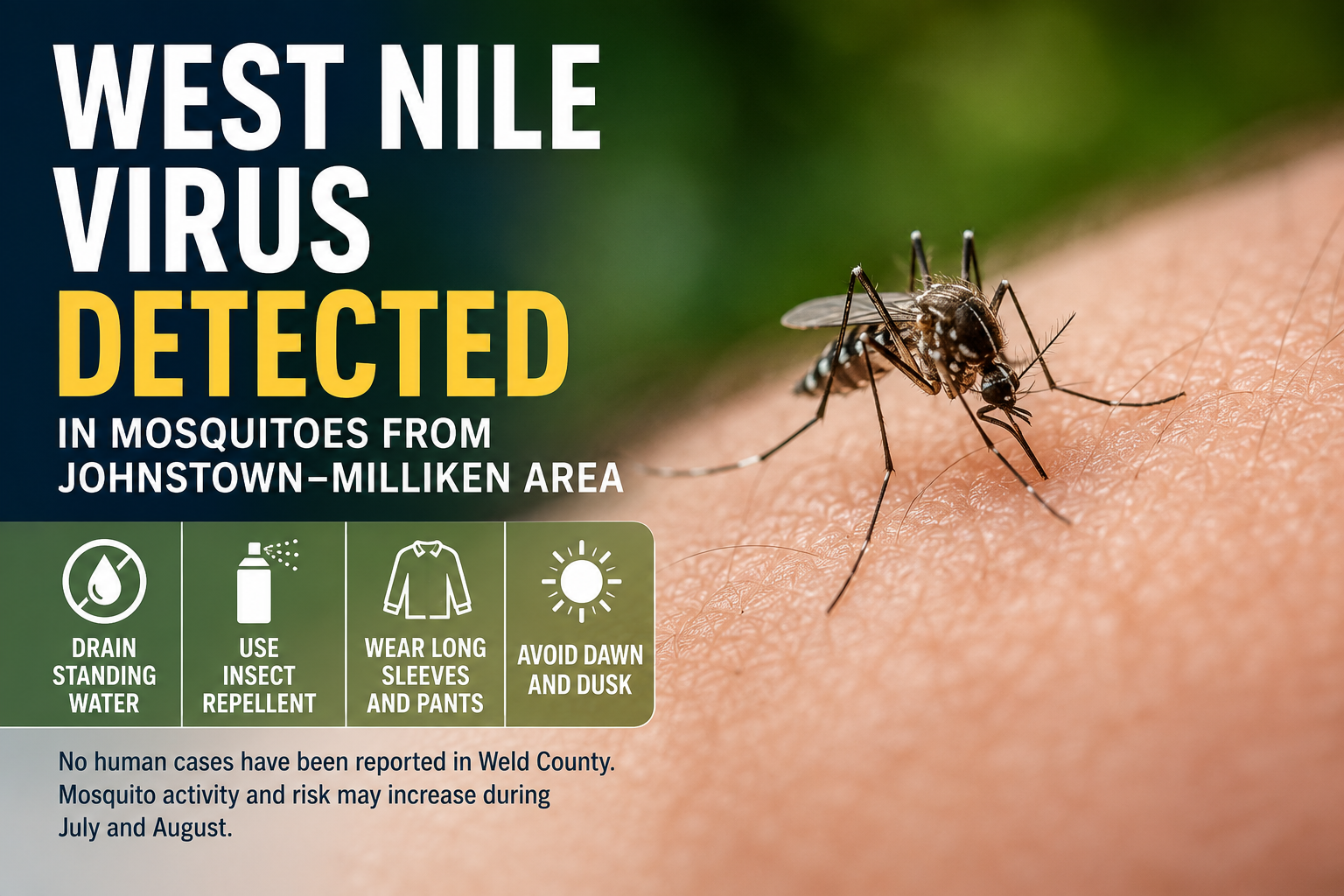
Mosquitoes collected from a Weld County monitoring zone that includes Johnstown, Milliken and Platteville have tested positive for West Nile virus, county health officials announced Thursday, July 23.
The positive mosquito pool was collected July 14 from Zone 2, one of three areas included in the Weld County Department of Public Health and Environment’s mosquito-surveillance program. The zone encompasses the Johnstown, Milliken and Platteville area.
According to the county’s announcement, the number of Culex mosquitoes collected through the monitoring program remains below the five-year average. No human cases of West Nile virus have been reported in Weld County this season.
County officials cautioned that mosquito activity and the potential for human exposure may increase as hot weather continues through July and August.
“Increasingly hot weather often creates favorable conditions for the Culex mosquito that carries West Nile virus,” Weld County Health Department Executive Director Jason Chessher said in the announcement. “The public needs to remain vigilant because West Nile virus has a permanent summer presence in Colorado.”
The positive test confirms that West Nile virus is circulating within the monitoring zone containing Johnstown, Milliken and Platteville. It does not establish that infected mosquitoes are present in every neighborhood or throughout each of the three communities.
Weld County recommends following the “4 Ds” of West Nile virus prevention: drain standing water, avoid outdoor activity at dusk and dawn, dress in long sleeves and pants when practical, and use an insect repellent containing DEET. Residents should regularly empty water from buckets, flowerpots, tires, gutters, toys and other containers where mosquitoes can breed.
The Centers for Disease Control and Prevention similarly recommends using an Environmental Protection Agency-registered insect repellent, wearing long and loose-fitting clothing and avoiding outdoor activity between dusk and dawn, when mosquitoes that spread West Nile virus are most active.
West Nile virus is transmitted to people through the bite of an infected mosquito. Many infections cause no symptoms, while others can produce fever, headaches, body aches or other flu-like symptoms. In rare cases, the illness can affect the nervous system and become severe. Additional information about symptoms is available from the CDC’s West Nile virus resource center.
Weld County’s contractor monitors mosquito traps weekly in three areas: Zone 1, covering Greeley, Evans, Kersey and La Salle; Zone 2, covering Johnstown, Milliken and Platteville; and Zone 3, covering Firestone, Dacono and Fort Lupton. The county posts current testing information on its West Nile virus surveillance page.