The article follows the Town Council’s July 13 work session, where officials considered how Johnstown should regulate potential data center development before any specific application is filed.
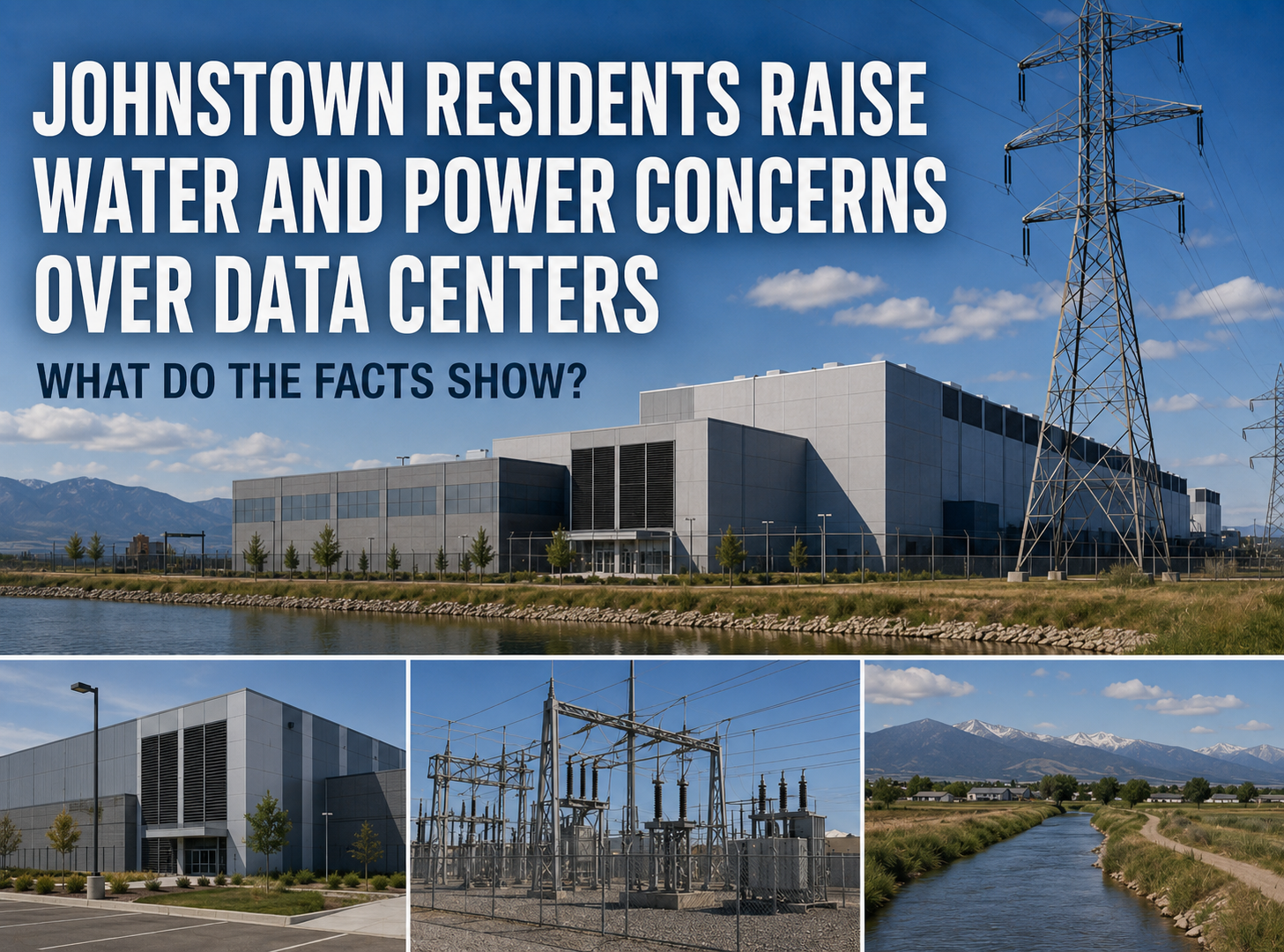
The possibility of future data center development has generated an intense response from Johnstown Republic readers, with water use, electricity demand, pollution and the use of limited industrial land emerging as the most common concerns.
Comments on a recent Johnstown Republic story were overwhelmingly opposed to data center development. Readers questioned whether northern Colorado has enough water to support large facilities, whether new electrical demand could affect existing customers and whether the potential tax revenue would justify using industrial land for facilities that typically employ relatively few people. Other commenters raised concerns about wastewater, environmental impacts and whether Town officials had already decided to pursue a project.
The response has been similarly lopsided in the Johnstown Republic reader poll. At the time these results were recorded, 181 people had voted in response to the question, “Should Johnstown allow data center development?”
Of those respondents, 173 — 95.6% — selected “No.” Five respondents, or 2.8%, said data centers should be allowed only with strict power and water requirements, while three, or 1.7%, voted “Yes.” No respondents had selected the options limiting development to smaller boutique data centers or saying they needed more information.
The poll is informal and unscientific. It reflects only readers who chose to participate and should not be interpreted as a representative survey of all Johnstown residents. The totals may also change as additional votes are cast.
There is another important point of clarification: the Town’s July 13 work-session materials did not identify a specific data center project, developer or site seeking approval. Instead, Town staff asked the council to consider whether Johnstown should establish rules for future proposals, including whether data centers should be permitted, reviewed through a special process or prohibited.
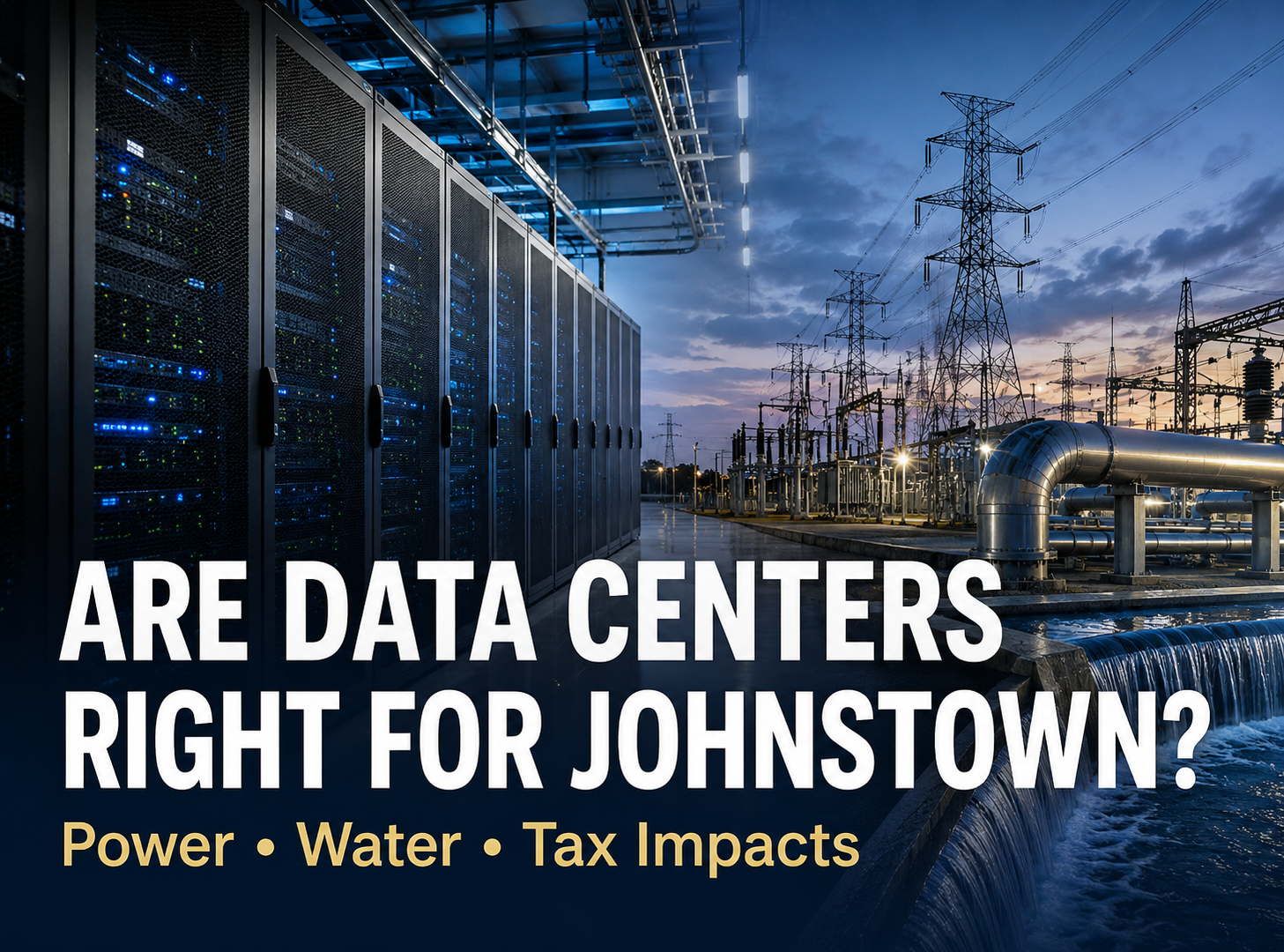
The concerns raised by residents are nevertheless worth examining. How much water would a data center actually use? Could a large facility affect electric rates? Does a closed-loop cooling system eliminate water concerns? And what can Johnstown learn from problems that have occurred elsewhere?
The available evidence does not support a single answer that applies to every data center. The impacts can vary dramatically based on the size of a facility, its cooling technology, its source of electricity and the conditions imposed by utilities and local governments.
Concern: Johnstown Does Not Have Enough Water
Water was the dominant concern in reader comments. Some pointed to current watering restrictions, while others argued that available water should be prioritized for residents, agriculture and future community growth.
Those concerns come during a period of mandatory conservation. Johnstown moved to Level 3 water conservation on April 20 because of low snowpack in the South Platte Basin, and the 2026 watering schedule limits most residential outdoor watering to two assigned days per week through Oct. 15.
Those restrictions are evidence that water conservation is a current issue for Johnstown, but they do not establish how much water a future data center would use.
In the Town’s July 13 materials, staff distinguished among cooling technologies with substantially different water demands. Open-loop evaporative cooling was identified as the most water-intensive of the systems reviewed. Closed-loop systems recirculate water, while direct-to-chip systems deliver liquid coolant directly to processors. Air cooling can require little or no process water but generally uses more energy for cooling.
The U.S. Department of Energy has similarly explained that traditional cooling towers remove heat by evaporating water and therefore require continual replacement of the water that is lost.
That distinction is central to the debate. A large facility relying heavily on evaporative cooling could present a very different water demand than one using dry cooling or a closed-loop liquid system.
Without a specific proposal, there is no defensible single number for how much water a hypothetical Johnstown data center would consume. Determining the impact would require knowing the facility’s size, expected annual and peak water demand, the source of that water, the cooling technology and how wastewater would be handled.
For residents who believe scarce water should not be committed to data centers at all, newer cooling technology may not resolve the underlying objection. Supporters, however, can reasonably argue that a low-water facility should not be evaluated as though it uses the same technology as a water-intensive evaporative system.
For many residents, the concern is also one of fairness: they question whether households should be asked to conserve water while the Town considers policies that could eventually allow a large industrial user with substantial resource demands.
Concern: “Closed Loop” Does Not Necessarily Mean Zero Water
Several readers questioned claims that a closed-loop cooling system would eliminate water concerns.
A closed-loop system is designed to recirculate cooling fluid rather than continually replacing water lost through evaporation. Johnstown’s staff materials characterized closed-loop cooling as relatively low in water use while noting that some makeup water may still be required.
Construction and commissioning can also involve water even when the finished cooling system is closed. Systems may need to be filled, flushed and maintained, creating a separate wastewater-management issue from the water used during normal operations.
There is also a distinction between water consumed directly at a data center and water associated with generating the electricity that powers it. The latter depends on the generation source and therefore cannot be calculated from the data center’s on-site water use alone. U.S. Department of Energy and National Renewable Energy Laboratory research has long documented that different electricity-generation technologies can have significantly different water requirements.
That means claims about a data center’s total water footprint need to identify what is being measured. A figure based on one electricity-generation mix cannot automatically be applied to a hypothetical project in Johnstown.
At the same time, cooling technology is evolving rapidly. Reuters reported July 1 that Valar Atomics and Nvidia are working on a small Utah data center intended to conserve water. The project pairs Valar’s microreactor technology with Nvidia’s closed-loop liquid-cooling approach as the companies seek to demonstrate a data center with sharply reduced water demand.
That example does not prove every future data center can operate with negligible water use. It does demonstrate why the actual engineering design of a project matters more than the generic label “data center.”
For Johnstown, a future review process could require a developer to disclose expected annual water use, peak demand, cooling technology, the source of the water and plans for handling wastewater. Whether those requirements would be enough to address residents’ concerns would remain a community and policy question.
Concern: Could a Data Center Raise Residents’ Electric Bills?
Electricity demand is another legitimate concern because the amount of power used by data centers varies enormously.
According to Johnstown’s July 13 data center presentation, Town staff estimated that Johnstown’s 8,097 housing units collectively consume approximately 26 megawatts during peak demand. The same presentation described boutique data centers as generally using between 1 and 15 megawatts, while hyperscale facilities can require 100 to more than 1,000 megawatts.
Those figures were presented by Town staff as illustrative comparisons, not estimates for a specific Johnstown project. They nevertheless show why it would be misleading to discuss all data centers as though they were the same. A smaller facility could consume less electricity than Johnstown’s current residential peak demand, while a hyperscale campus could require many times more power than the town’s homes combined.
Several readers questioned whether existing customers could eventually pay for substations, lines or other infrastructure needed to serve a major new electrical load.
Johnstown’s staff report also states that Xcel Energy and United Power have large-load processes requiring major applicants to fund studies and infrastructure upgrades associated with their demand. The stated purpose of those processes, according to the Town’s presentation, is to limit impacts on existing customers’ rates and access to reliable power.
That means it would be inaccurate to assume that a data center automatically forces residential customers to pay for all of its dedicated electrical infrastructure. It would be equally premature to conclude that an exceptionally large new electrical load could never have broader implications for generation, transmission or regional capacity.
The effect would depend on the project’s size, the serving utility, available capacity, the source of electricity and the agreements governing infrastructure costs.
Concern: What Happened Near Cheyenne?
Several readers cited a recent contamination incident associated with construction of Meta’s data center near Cheyenne as evidence that closed-loop cooling systems can still create environmental risks.
The underlying incident is real. SFGate reported that a rare bacterium was found in Cheyenne’s reclaimed-water system and traced to wastewater associated with a contractor working on Meta’s 715,000-square-foot data center project. The affected system was a reclaimed-water system used for irrigation, and the city’s drinking-water supply was not reported as contaminated.
The incident was associated with wastewater generated during work on the cooling system rather than evidence that the finished data center’s normal closed-loop operation contaminated drinking water. Reporting on the incident described the wastewater as coming from a fill-and-flush process used during construction and commissioning of cooling-system piping.
That distinction is important. The incident does not establish that operating data centers routinely contaminate drinking water. It does show that a project using closed-loop cooling can still create wastewater during construction, commissioning or maintenance.
For Johnstown, the lesson is that water consumption and wastewater management are separate questions. A future development policy could address where construction and commissioning wastewater may be discharged, what testing is required and whether pretreatment or off-site disposal is necessary.
Concern: Data Centers Use Land but Create Few Jobs
Another common criticism is that data centers can occupy substantial amounts of land while creating relatively few permanent jobs compared with other major commercial or industrial developments.
Johnstown’s own staff analysis acknowledges that data centers generally have low employment density and generate less secondary economic activity for sectors such as retail and hospitality. The same analysis notes that permanent employment can include higher-paying technical positions and that construction can generate significant temporary employment.
The economic argument in favor of data centers is different. The Town’s analysis identifies substantial property and business-personal-property tax revenue, combined with relatively limited demand for municipal services, as potential fiscal advantages.
Residents also raised concerns about noise, air pollution and backup generators, issues the Town’s own staff materials identify as potential subjects for future development standards.
To illustrate the potential, Town staff created a fictional case study rather than an actual proposal. The model assumed a 35-megawatt data center with $2 billion in machinery and equipment. Under the staff’s five-year depreciation scenario, the hypothetical project was estimated to generate approximately $38.8 million in Town tax revenue before a hypothetical 50% incentive refund, leaving approximately $19.4 million in net new revenue to Johnstown over the five-year period.
Those figures are illustrative only. They do not represent a proposed facility, a guaranteed tax return or an offer currently before the Town.
The policy question is therefore not simply whether a data center would create jobs. It is whether Johnstown would prefer an industrial use that may employ fewer people but potentially generate substantial taxable investment with relatively low ongoing demand for municipal services, or whether limited industrial land should be reserved for development with a larger employment and secondary-spending footprint.
There is no purely factual answer to that choice. It is a question of community priorities.
Concern: Has the Town Already Made Up Its Mind?
Some residents responding to the discussion assumed a data center was already planned or that Town officials had effectively decided to approve one.
The publicly available July 13 work-session materials do not identify a specific data center developer, site or application seeking approval in Johnstown. Instead, Town staff asked the council to consider whether data centers should be permitted by right, reviewed through a Use by Special Review process or prohibited.
The Town also asked whether Johnstown should create a dedicated land-use classification for data centers, whether smaller boutique and large hyperscale facilities should be treated differently and what standards should address issues including electricity demand, water use, cooling systems, backup power, noise and environmental impacts.
That distinction is important: the policy discussion was not an approval hearing for an identified data center project.
At the same time, residents who want to influence the issue have reason to pay attention before an application is filed. Rules adopted in advance could determine what kinds of projects are eventually allowed, where they could be located and what conditions a developer would have to meet.
What the Facts Do — and Do Not — Show
The evidence does not support treating every data center as though it has the same impact.
Johnstown’s own materials distinguish between boutique facilities using roughly 1 to 15 megawatts and hyperscale campuses that can require 100 to more than 1,000 megawatts. The Town also distinguishes among cooling technologies with significantly different relative water demands.
The concerns raised by residents are therefore not baseless. Large data centers can require enormous amounts of electricity. Traditional evaporative cooling systems can consume substantial amounts of water because evaporated water must continually be replaced. Johnstown’s own analysis acknowledges relatively low permanent employment density, and the Cheyenne incident demonstrates that wastewater management can create problems even when the finished cooling system is intended to operate as a closed loop.
At the same time, the available evidence does not support claims that every data center would consume enormous quantities of Johnstown’s drinking water, automatically increase residents’ electric bills or inevitably contaminate the local water supply. Those outcomes would depend on the size of the facility, its technology, its water source, its electricity provider and the conditions imposed before development.
For Johnstown, the immediate question remains whether the Town should establish rules before a proposal arrives.
Those rules could address water-source requirements, limits on potable water consumption, cooling technology, disclosure of peak resource demands, responsibility for electrical infrastructure, wastewater testing and disposal, and performance standards tied to any public incentives. Those are among the types of issues Town staff asked the council to consider in its July 13 policy discussion.
Whether any set of protections would be enough to change public opinion remains an open question. Among the 181 Johnstown Republic readers who had participated in the poll when these results were recorded, 95.6% selected “No” when asked whether Johnstown should allow data center development.
That result is not a scientific measure of community opinion. But combined with the volume and intensity of reader comments, it shows that any future discussion of data centers in Johnstown is likely to face close public scrutiny.
Editor’s note: The Johnstown Republic poll is an informal, unscientific reader survey. Results cited in this article reflect 181 votes recorded at the time of writing and may change as additional readers participate.