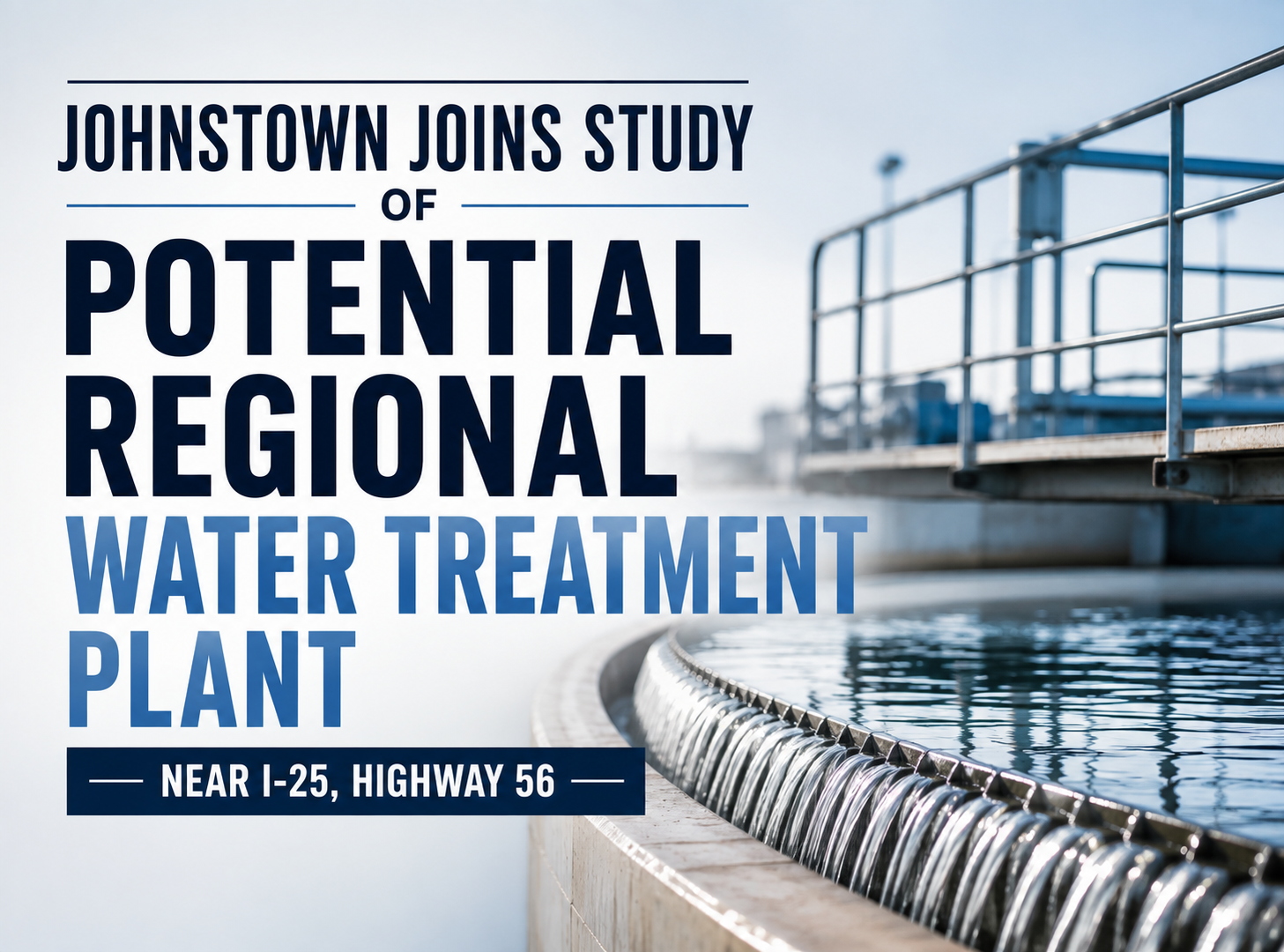
Johnstown is joining seven other Northern Colorado water providers in a $400,000 engineering study examining whether a regional water treatment plant near Interstate 25 and Colorado Highway 56 could provide a practical way to meet future water needs.
According to reporting on the Berthoud Board of Trustees’ approval of the intergovernmental agreement, the study includes the Town of Johnstown, Central Weld County Water District, Berthoud, Dacono, Frederick, Milliken, Left Hand Water District and Little Thompson Water District. The eight participants are expected to share the $400,000 consulting cost equally, putting each provider’s contribution at approximately $50,000.
At this stage, the communities are studying whether the concept is feasible. A regional water treatment plant has not been approved for construction, and major questions including the exact site, treatment capacity, ownership structure and eventual construction cost have not yet been determined.
Berthoud Water and Wastewater Utilities Director Ken Matthews told trustees that most of the study is expected to be completed during the first quarter of 2027, with the participating providers holding workshops as the engineering work progresses.
For Johnstown, the study adds another component to a much broader effort to prepare its water system for continued residential and commercial growth.
Regional cooperation has been developing for more than a year
The current study is the latest step in an effort among Northern Colorado water providers that was already underway in 2025.
Minutes from the Little Thompson Water District’s July 17, 2025, board meeting show that representatives from Central Weld County Water District, Dacono, Evans, Frederick, Johnstown, Left Hand Water District, Milliken and Little Thompson were participating in discussions regarding a possible regional water authority. The minutes specifically noted that Johnstown was interested in being part of that regional effort.
By late 2025, Johnstown was one of nine providers participating in a formal intergovernmental agreement to share legal expenses while exploring potential regional water projects and the possible creation of a regional water authority.
Official documents from the City of Dacono identified the participants as Central Weld County Water District, Berthoud, Dacono, Evans, Frederick, Johnstown, Milliken, Left Hand Water District and Little Thompson Water District. The agreement allowed the organizations to jointly explore possible projects, contracts and cost-sharing arrangements involving their potable water systems.
The agencies also agreed to share preliminary legal expenses associated with that work, with the initial total estimated at no more than $25,000.
The new engineering study advances that regional discussion beyond the organizational and legal stage by examining a specific infrastructure concept: construction of a shared treatment facility in the vicinity of I-25 and Highway 56.
The group involved in the current study is slightly different from the earlier regional effort. Evans participated in the 2025 discussions but is not among the eight providers identified in the current treatment-plant study.
Why a regional plant is being considered
The basic premise behind a regional facility is that several rapidly growing water providers may be able to share some treatment infrastructure rather than each developing similar facilities independently.
During Berthoud’s consideration of the agreement, Matthews said there can be efficiencies when multiple providers work together instead of duplicating infrastructure individually.
That need is not theoretical for some of the participants. Little Thompson Water District says additional treatment infrastructure will be needed to serve the full buildout of the Barefoot Lakes area. The district says it is working with seven other water providers on a potential new regional treatment plant as part of its long-term planning for treatment capacity.
The I-25 and Highway 56 corridor is also an area experiencing substantial development pressure. Berthoud’s Water and Wastewater Master Plan notes that development along the I-25 corridor has accelerated and that portions of the town’s existing water and wastewater infrastructure will require additional capacity as growth continues.
For Johnstown, however, participating in the study does not replace the substantial improvements already underway within the town’s existing water system.
Johnstown is already expanding its own treatment capacity
Johnstown is currently expanding its existing water treatment plant from approximately 6 million gallons per day to 12 million gallons per day.
According to the Town’s Water Treatment Plant Expansion project page, the expansion is intended to meet existing water demand while providing capacity for future population growth. The site is ultimately planned to accommodate approximately 21 million gallons per day of treatment capacity.
Johnstown is also advancing a major raw-water transmission project designed to increase the amount of untreated water that can be delivered to the plant. The Town’s Raw Water Transmission Project includes roughly 11 miles of 30-inch transmission pipeline along with new and upgraded pumping infrastructure.
Those projects address water infrastructure Johnstown has already determined it needs. The regional treatment-plant study is instead looking farther into the future at whether cooperation with neighboring providers could eventually provide additional capacity, redundancy or other operational benefits.
The distinction is important. Johnstown’s existing plant expansion and raw-water pipeline are active capital projects, while the regional facility remains a concept undergoing feasibility analysis.
What happens next
The current engineering study is expected to help the eight participating providers determine whether the regional treatment-plant concept makes technical and financial sense and whether it warrants more detailed planning.
Questions still to be resolved include how much capacity each provider would need, the exact location of a plant, how participating water systems would connect to it, how costs would be divided and what organization would eventually own or operate the facility.
The study is expected to be largely completed during the first quarter of 2027. Only after that work is completed would the participating governments be positioned to determine whether the project should advance toward detailed design, financing, permitting and eventual construction.
For Johnstown, participation represents a longer-term layer of water planning beyond the projects already underway within town. It also shows that as Northern Colorado communities continue to grow, some of the infrastructure needed to support that growth may increasingly be planned across municipal and water-district boundaries rather than by individual communities alone.