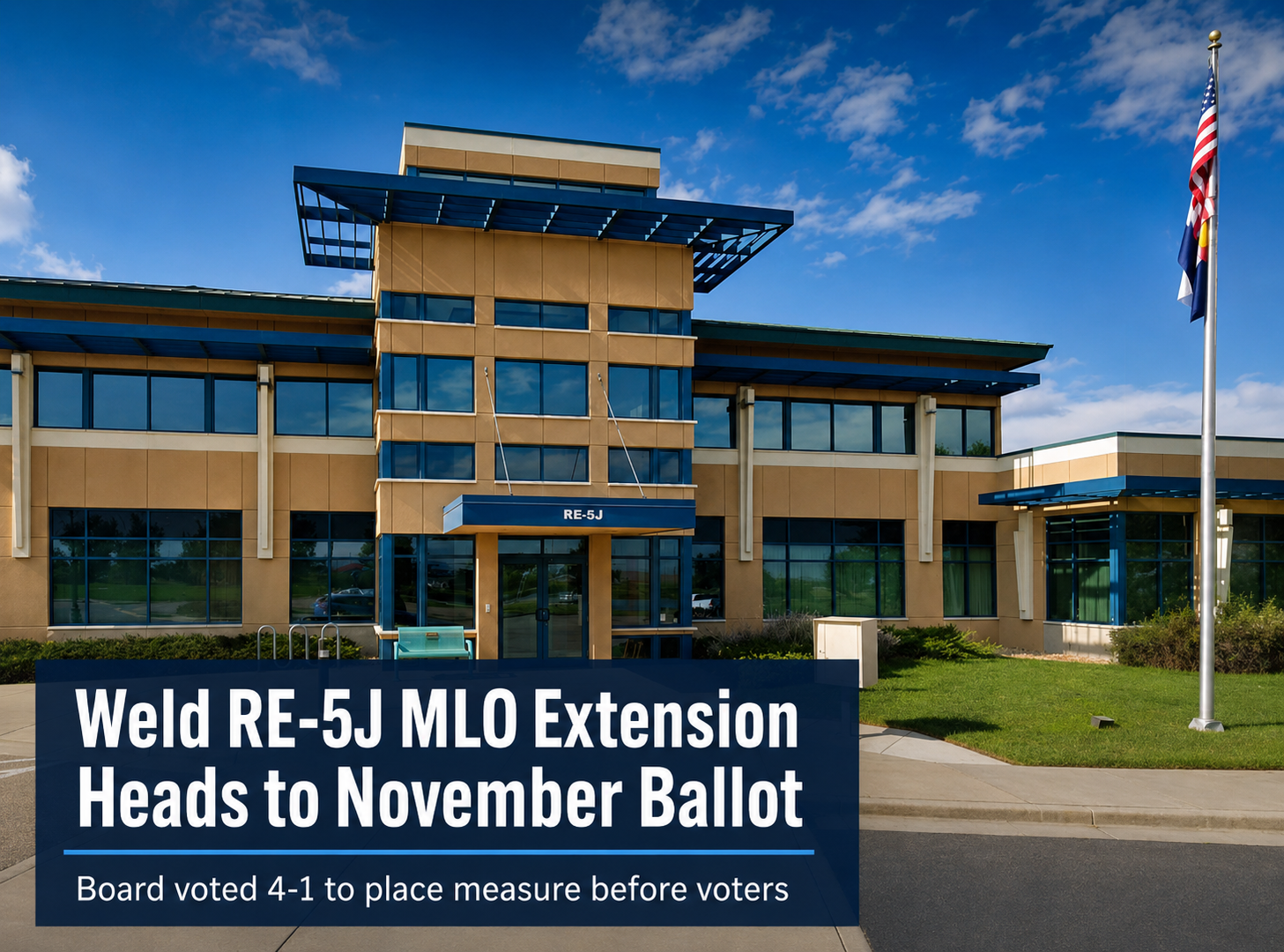
Weld RE-5J voters will decide this November whether to extend a $4 million annual mill levy override that currently helps fund staffing, school safety, mental health services and other district operations.
The Board of Education voted 4-1 on Aug. 19 to place the measure on the November ballot. The proposal would extend the district’s existing 2020 mill levy override beyond its scheduled 2030 expiration rather than increase the amount of annual revenue authorized under the measure. Weld RE-5J describes the proposal as continuing existing funding without imposing a new tax increase.
The district currently receives $4.5 million annually through two voter-approved mill levy overrides. A measure approved in 2003 provides $500,000 each year with no expiration date, while voters approved an additional fixed $4 million annually in 2020 for a 10-year period ending in 2030.
Because the overrides authorize fixed dollar amounts rather than a fixed mill rate, the number of mills needed to generate the revenue has declined as assessed property values within the district have increased. According to the district, the two overrides required a combined 8.85 mills in 2021. In 2026, approximately 3.52 mills are required to generate the same $4.5 million.
The November election will not determine whether the current $4 million override ends immediately. If voters reject the extension, the existing authorization would remain in place through 2030, and the district could ask voters to consider another proposal before it expires.
District officials say they are asking voters to make the decision four years ahead of the expiration because the $4 million represents a significant portion of Weld RE-5J’s operating budget. The district estimates its annual budget at approximately $50 million, making the 2020 override equal to nearly 8% of available funding.
According to Weld RE-5J, mill levy override revenue has been used for additional safety and security staffing, student mental health services, career and college programming, transportation needs and other operating expenses. If the extension is approved, the district says the funding would continue supporting staff recruitment and retention, safety and mental health personnel, career preparation programs and early childhood programming.
The district has also tied the request to continued enrollment and operating-cost growth. Weld RE-5J reports that enrollment increased from approximately 3,200 students in the 2018-19 school year to 4,205 in 2025-26, an increase of about 31%. During that period, the district has also increased staffing and compensation, including raising its starting teacher salary from $39,857 in 2020 to $51,258 in 2026.
If the extension is not ultimately approved before the existing override expires in 2030, the district says it would have to account for the loss of approximately $4 million in annual revenue. Potential effects identified by the district include staffing reductions, larger class sizes, less competitive employee compensation and fewer student programs and opportunities.
The mill levy override extension will appear before Weld RE-5J voters in the Nov. 3, 2026 election.